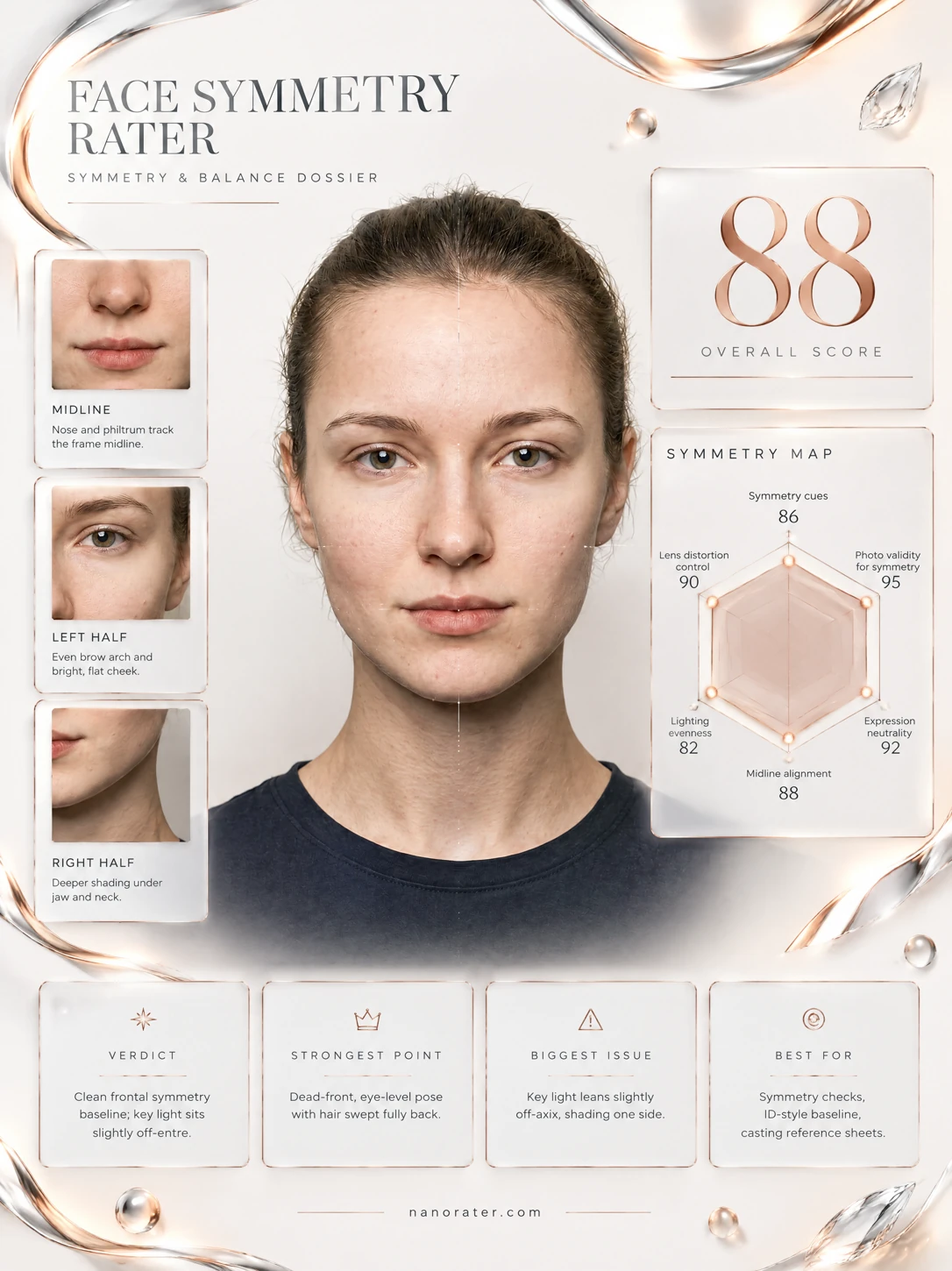
A real report, captured
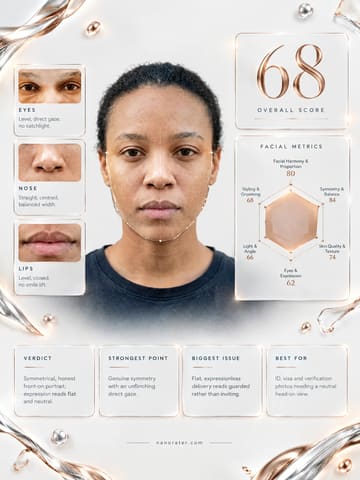
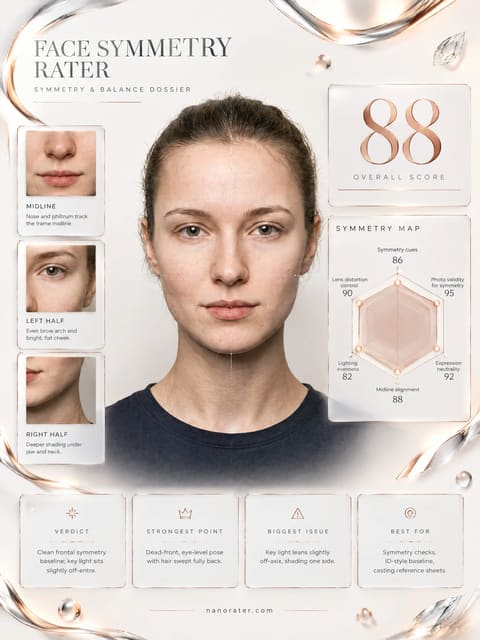
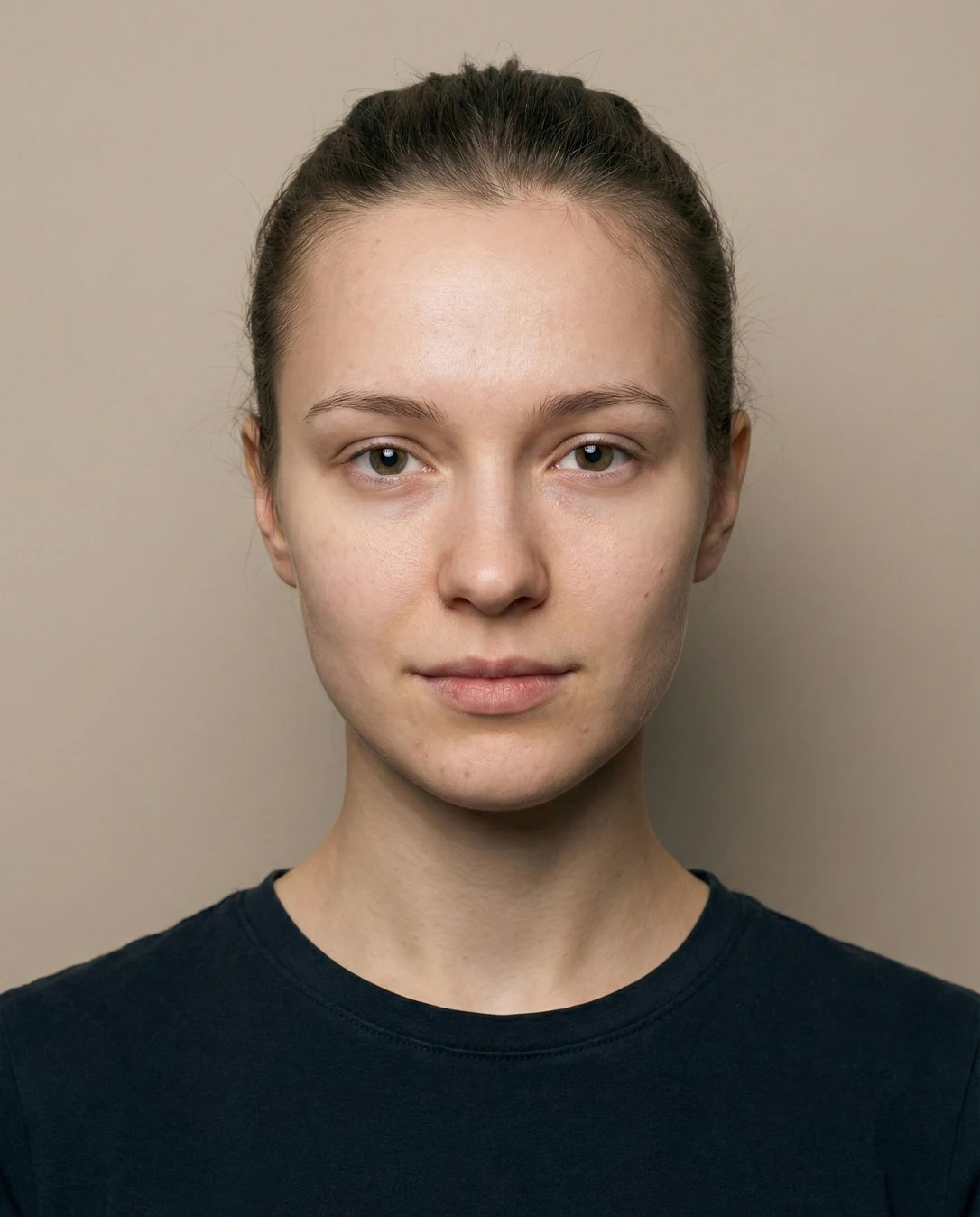
Okay, you basically handed me the textbook frame for this test — dead-on, eye-level, hair back, plain wall, and a face that actually holds still — so this is a clean read rather than a guessing game, and honestly the number is high because you made the job easy.
Where this photo works
This is a symmetry-reference frame and it does that job properly: passport-style and casting baselines, clinical before/after reference, makeup, brow and grooming consultations, and any tool that needs a straight-on neutral face in even light. It does not work as a warm social profile, a dating-style portrait or a moody editorial — the neutral mouth and flat, controlled light read cool and impersonal next to an expressive alternative, and there is no mood, styling point of view or story for a casual viewer to latch onto. Crop it square and it survives as an avatar, but a chat profile would lose more than it gains from the deliberately clinical register.
Quickest fixes
- Flip the image horizontally and compare — this separates real structure from lens and lighting artifacts.
- Set the eye line dead center with a tight head-and-shoulders crop for a cleaner, more comparable read.
- Lift shadows roughly 5-8 points on the softer side of the face to even the shading without touching structure.
Retake plan
- 1.Place the camera on a tripod at exact inner-canthus height so there is no upward or downward angle.
- 2.Use a 50-85mm equivalent lens at 1.5-2.0 m distance to keep perspective flat and the mid-face undistorted.
- 3.Light with either a single source on the lens axis or two matched softboxes at 45 degrees with identical power and distance, plus a small fill under the chin.
- 4.Keep the backdrop plain and check that all four corners read the same tone before shooting.
- Photo Validity For Symmetry93
Front-facing, centered, eye level just above frame center, plain background, head-and-shoulders framing, no visible head tilt. Both eyes, both brows and both ears are visible, which confirms a true front-on view rather than a turned one.
- Eye Line And Lid Balance84
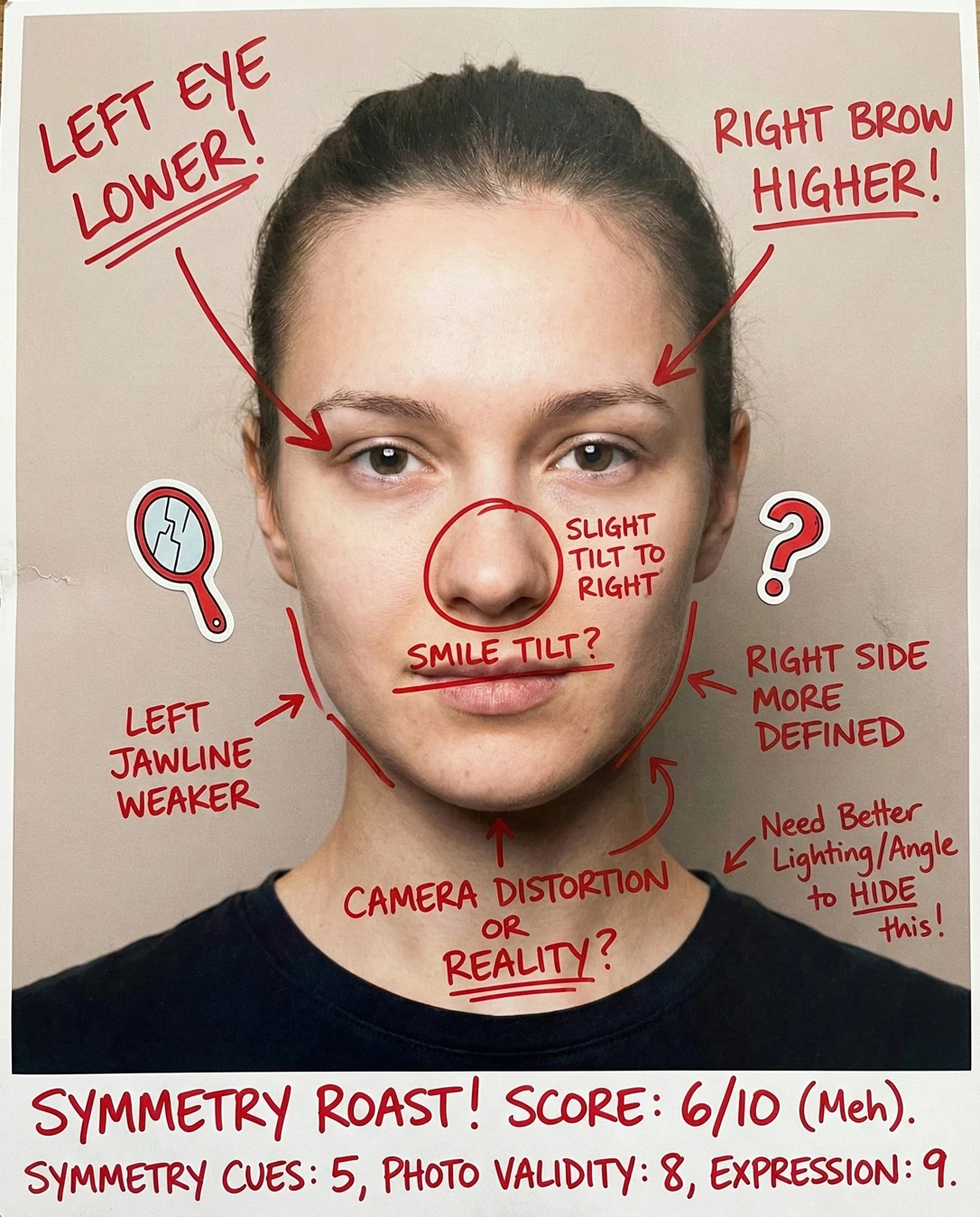
The pupils sit on an essentially level horizontal line, with gaze directed straight into the lens. Upper-lid exposure differs marginally: one lid covers slightly more of the iris while a fraction more sclera shows beneath the other eye, a difference amplified by the uneven under-eye shading.
- Brow Height And Arch82
Both brows are visible and broadly matched in thickness and natural density. The arch apex sits marginally higher on one side and its tail extends slightly further laterally, which tilts the perceived horizontal line across the upper face.
- Midline Alignment90
The bridge, the philtrum and the chin point run essentially on a single vertical track in this view, with no measurable deviation of the nose axis and the forehead center sitting close to that line.
- Jawline And Chin Balance85
Jaw contours are broadly similar on both sides, with the mandible angle falling at comparable heights. Chin mass reads fractionally fuller on one side of frame, and neck shading shifts with the light rather than with bone structure.
- Mouth Line And Neutrality86
Lips are closed and relaxed with no smile, and the lip line runs close to level. There is a very slight drop at one mouth corner, plus a faint compression where the lips meet, both of which are resting tension rather than shape.
- Perspective And Distortion88
Nose-to-face proportion looks natural, both ears are visible at comparable size, and there is no wide-angle bulge or foreshortening of the mid-face. The head reads vertical with no roll.
- Light Evenness Across The Axis80
Illumination is frontal and soft with a plain, well-separated backdrop. A mild left-to-right tonal gradient remains in the cheek, jaw and neck shading, and the under-eye area shows a slight tonal difference side to side that reads as structure at small sizes.
- Expression Neutrality92
Gaze is direct and steady into the lens, brows are relaxed, there is no squint or smile, and the face is relaxed enough to read as a genuine resting state rather than a held pose.
What works
- True front-on, eye-level camera axis
Centered subject, both eyes and ears visible, eye line just above frame center, no roll or yaw.
- Genuine neutral expression with direct gaze
Closed relaxed mouth, unraised brows, steady eye contact at the lens.
What holds it back
- Marginal eyelid exposure difference
One upper lid covers slightly more of the iris with a fraction more sclera visible below the opposite eye.
- Brow arch and tail mismatch
One arch apex sits marginally higher and its tail extends slightly further laterally than the other.