
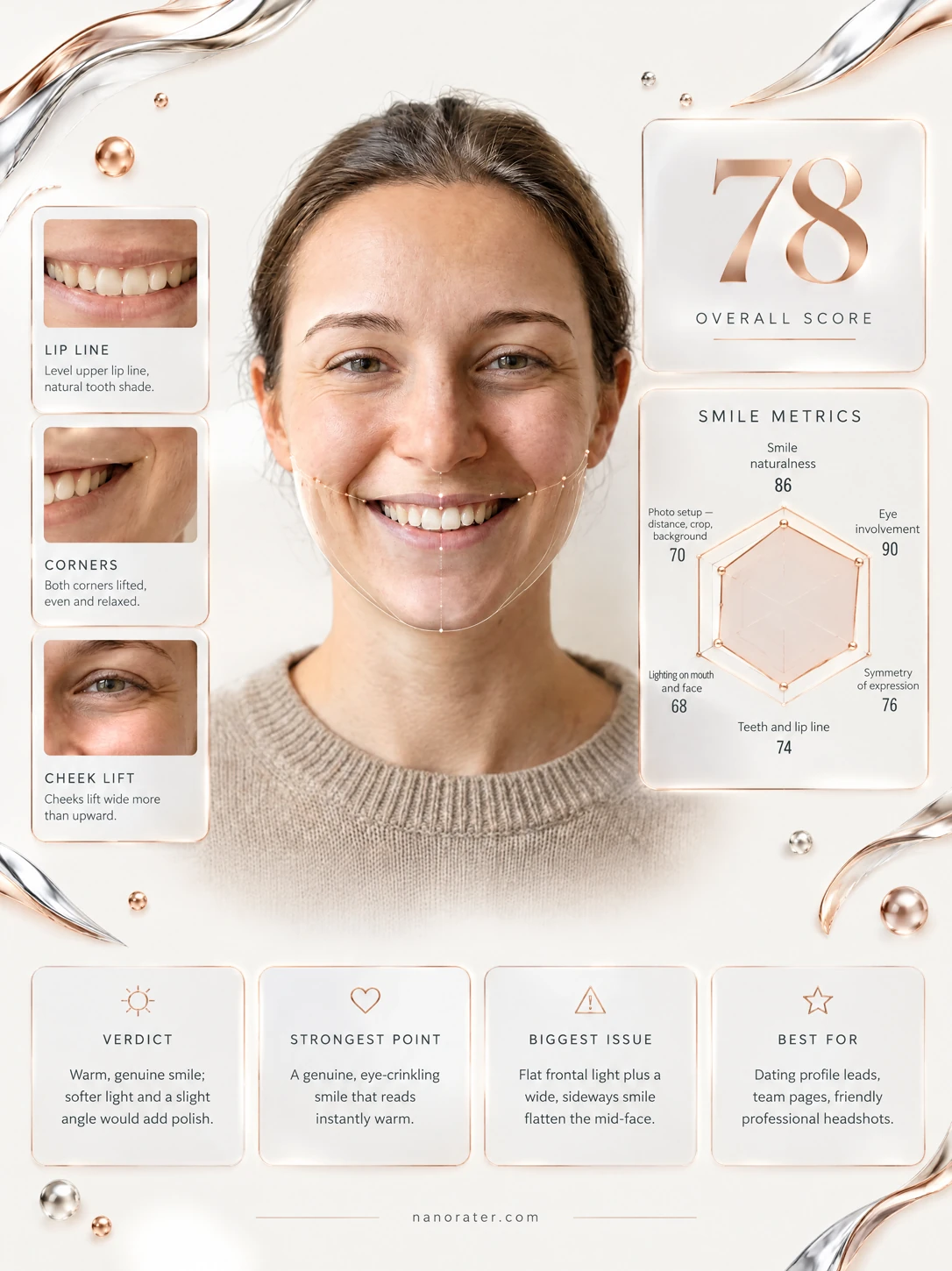
A real report, captured
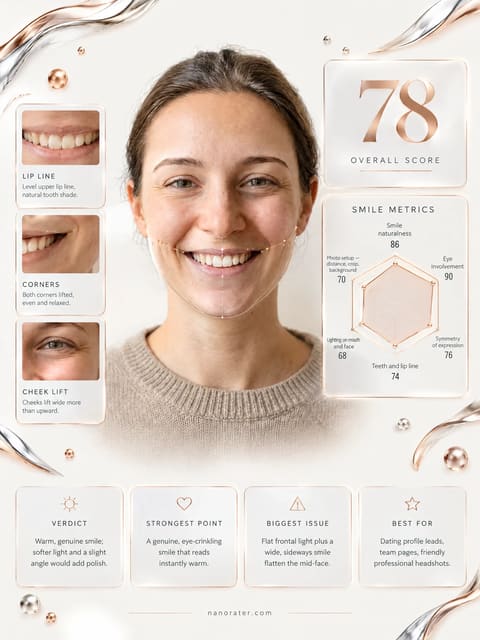
That's a genuinely lovely smile — wide, warm, and it reaches your eyes the way a real laugh does; the light and framing just aren't quite keeping up with it, and that's the easy part to fix.
Where this photo works
Works beautifully as a friendly profile photo for social platforms, team pages, dating profiles and personal-branding intros where approachability is the whole point — the teeth-forward, eye-crinkling smile reads instantly at thumbnail size. It works less well for anything needing polish or depth: an editorial or executive headshot, a hero image on a website, or a tightly cropped circular avatar, where the dead-front-on angle and the beige wall behind you flatten the frame and merge with the knit.
Quickest fixes
- Raise the camera to just above eye level and tip the chin a fraction down and forward — instant jaw definition with no change to the smile.
- Step back to 1.2-1.5 m and use mild zoom instead of standing close; this removes the front-on enlargement of the nose and mid-face.
- Turn the shoulders about 10° off the wall while keeping your eyes on the lens, giving the frame depth and a slimmer silhouette.
Retake plan
- 1.Light: stand side-on to a large window at roughly 30-45°, about 1 m back from the glass, and turn off any overhead ceiling light so no shadow drops from the brow onto the eyes.
- 2.Camera distance: place the camera 1.2-1.5 m away at eye height or slightly above, and use 1.5-2x zoom rather than moving closer; this keeps proportions natural.
- 3.Angle: rotate the shoulders 10-15° away from the lens, keep the head turned back to face the camera, and ease the chin down and slightly forward for a defined jaw.
- 4.Framing: leave about one palm width of headroom above the hair, include down to the collarbone, and keep both ears comfortably inside the frame.
- Smile Naturalness84
Mouth corners are lifted evenly on both sides with no downward pull, the jaw looks unclenched at the masseter line, and the lower lip shows the slight thinning that accompanies a genuine broad smile rather than a held, symmetrical 'camera smile'.
- Eye Involvement / Approachability82
Lower eyelids are raised and slightly tensed, fine lines radiate at the outer eye corners, and the gaze holds the lens directly — the smile visibly originates above the mouth, which is what makes it read as warm rather than polite.
- Symmetry of Expression76
Expression is well balanced overall; the visible tooth line sits marginally off the lip midline and the left and right mouth corners show a very small difference in height. Because the head is squared dead-front-on, any minor variance is maximally visible rather than being absorbed by an angle.
- Lighting on Mouth and Teeth76
Light is soft, broad and near-frontal — no hard shadow crosses the teeth or drops under the lower lip, which is a genuine strength. The trade-off is a slightly shaded zone under the nose and along the photo-right cheek, and a general flatness that removes modelling from the mid-face.
- Teeth Presentation and Undertone74
A generous, confident display of the upper row with even exposure across the visible enamel and a natural warm off-white undertone; the lower portion of the mouth falls into slight shade, and the smile stretches wide enough that the corners sit close to the frame of the lips.
- Framing and Headroom71
The crop is tight: the hair sits close to the top edge with minimal headroom, both ears just inside the frame, and the composition terminates at the collarbone. It is a clean head-and-shoulders read, but the tightness compresses the top of the head and leaves no room for the frame to breathe.
- Camera Distance and Angle69
The square-on head position with both ears equally visible and a slightly widened mid-face points to a fairly close camera at roughly face level, which flattens depth and removes the off-axis modelling that separates facial planes.
- Background Separation68
The wall sits directly behind the shoulders in a warm beige that is very close in value and temperature to the oatmeal knit, so the silhouette does not separate and the head has no halo of contrast to sit against.
- Small-Size Read / Instant Warmth81
At reduced size the smile, direct gaze and warm skin tones communicate friendliness immediately; the face is well centred and the eyes land on the upper third, which is exactly where a scrolling viewer looks first.
What works
- A smile that actually reaches the eyes
Cheeks are lifted high under the eyes with visible outer-corner crinkling and raised lower lids — the smile is generated from the whole face, not just the mouth.
- Clean, even light with no hard shadow on the teeth
Exposure is uniform across the mouth area with no hard-edged shadow crossing the lip line or enamel, and skin highlights on the forehead and cheekbones stay controlled.
What holds it back
- Flat frontal angle removes facial modelling
Both ears are equally visible and the head sits square to the lens, so the light has no angle to carve across the cheekbones, jaw or nose bridge.
- Background merges with the subject in tone and distance
A close beige wall at near-identical value to the oatmeal knit means no tonal edge between hair, shoulders and backdrop.