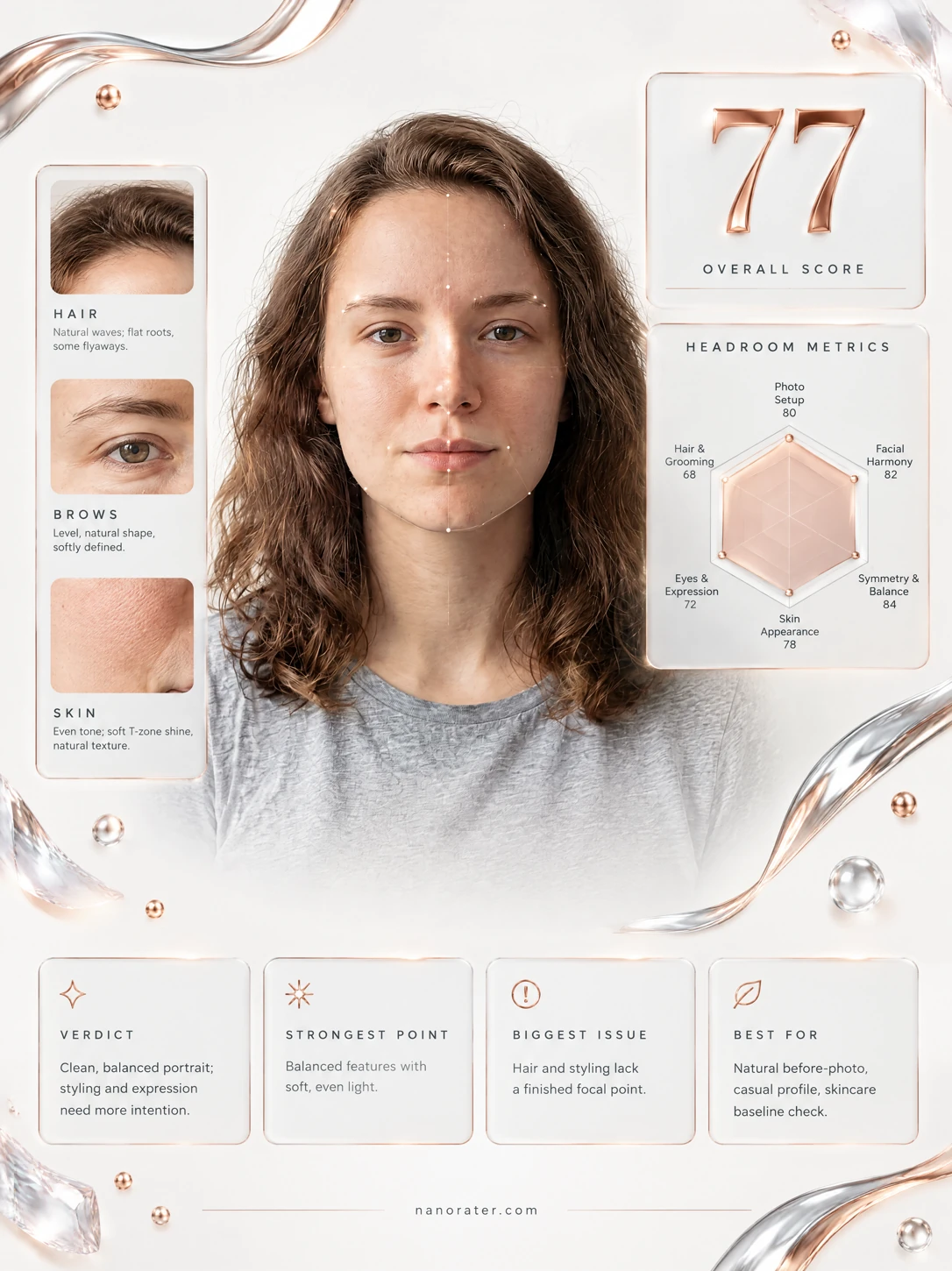
A real report, captured
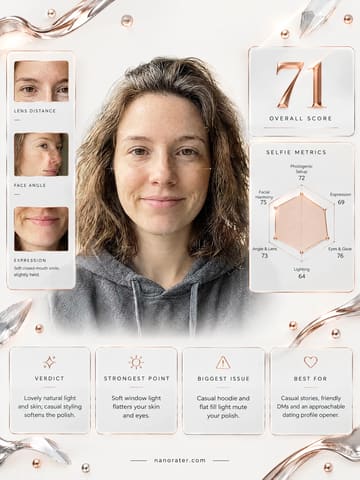
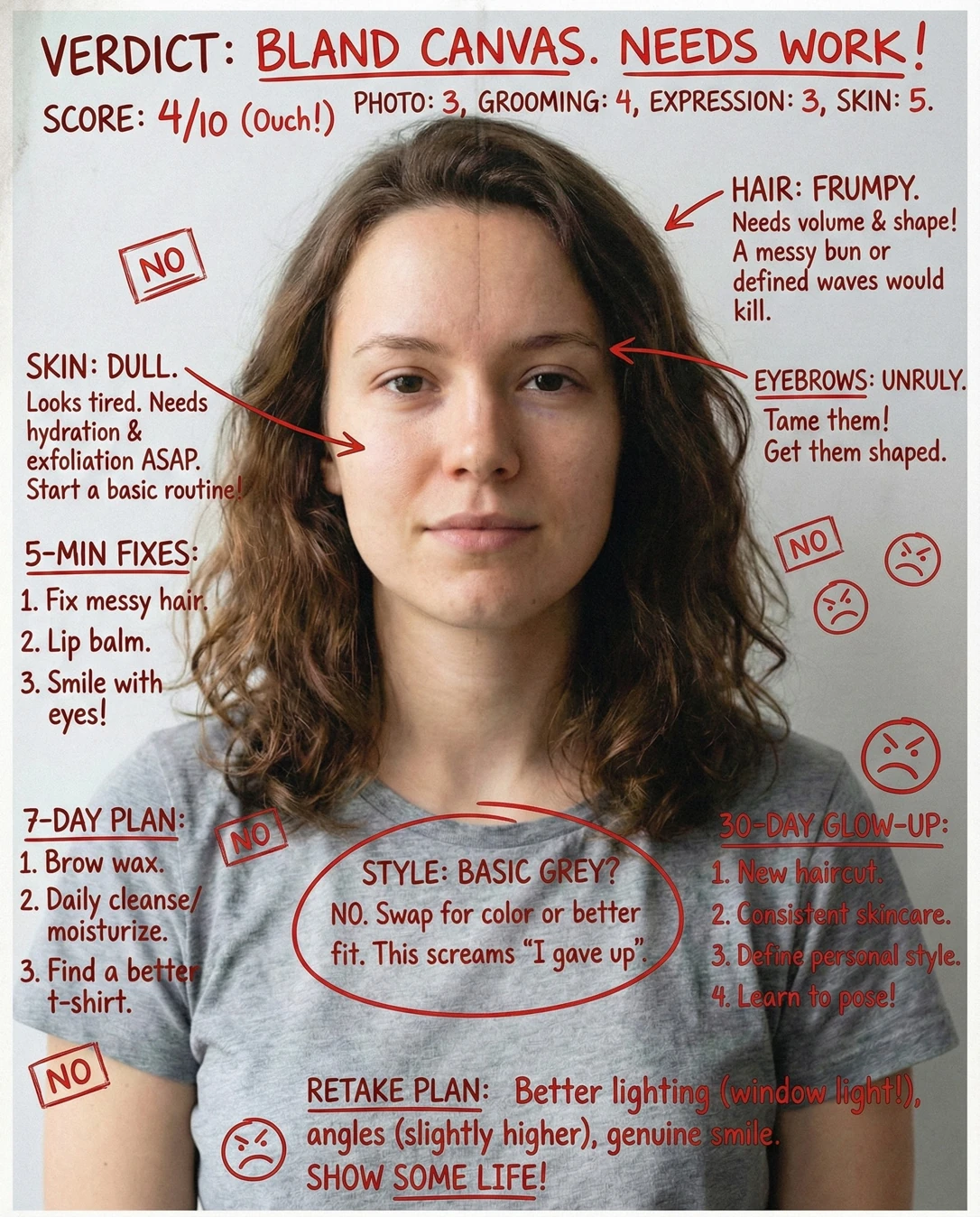
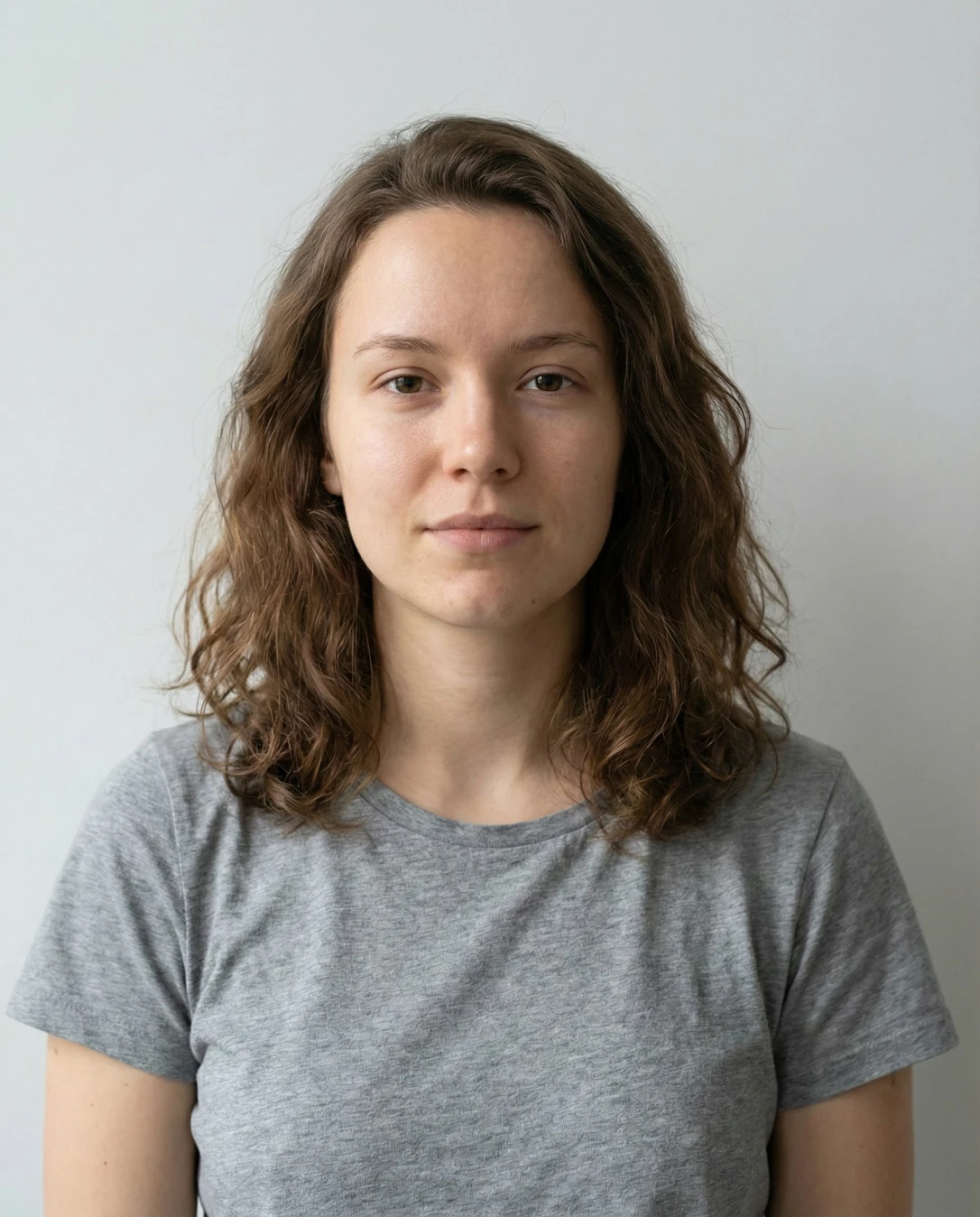
There is a lovely, steady face in here — clean features, honest light, zero gimmicks — but the camera is treating you like a passport photo instead of a portrait. You are literally one window, one shoulder turn and one step back from a photo that looks like you on a genuinely good day.
Where this photo works
This is a straight-on, evenly lit headshot with a plain wall behind it: it works beautifully for LinkedIn, job applications, ID-adjacent headshots, a professional profile thumbnail and as an honest 'before' frame in a glow-up set. It reads clearly even at tiny sizes. Where it does not work: dating apps, social avatars that need personality, or anything selling mood and warmth — the full-front angle, shadowless light and plain gray tee make it feel like documentation rather than presence, and the neutral expression gives a viewer nothing to lean into.
Quickest fixes
- Five minutes: turn one shoulder 20-25 degrees away from the camera and step back two paces, or switch to 2x zoom, to correct perspective.
- Five minutes: angle your face 45 degrees into a window so one cheek is lit and the other falls into soft shadow — instant cheekbone and jaw definition.
- Five minutes: chin slightly forward and down, drop the shoulder nearest the lens, exhale, then shoot a burst of ten frames.
Retake plan
- 1.Set up 1.5-2 m from the camera, or shoot at 2x zoom from the same distance, so perspective distortion stops enlarging the near features.
- 2.Stand 45 degrees to a window or single light source, letting one side of the face carry the light and the other fall into soft shadow; raise the source slightly above eye level so a gentle shadow sits under the cheekbone and jaw.
- 3.Turn the body to a three-quarter angle rather than straight-on, keeping the far shoulder slightly back so the silhouette tapers and depth returns to the face.
- 4.Position the background at least one metre behind you so it softens, and choose a wall one to two stops darker than your skin or one with texture for a clean edge around the head and shoulders.
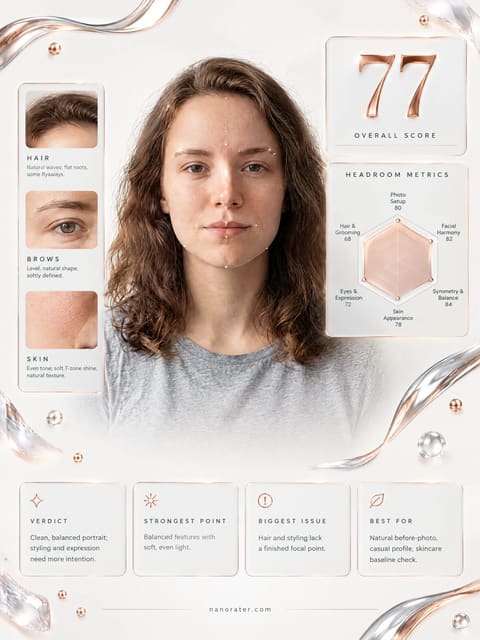
- Facial Harmony78
Facial thirds are balanced, the mid-face and jaw taper evenly, and feature spacing reads proportionate; the close straight-on capture mildly enlarges the forehead and nose relative to the ears, slightly shortening apparent face length.
- Symmetry & Balance84
Left and right sides are near-even at eye line, brow height and mouth; a slight natural asymmetry in brow arch and eyelid fold is visible but reads as human rather than off-balance.
- Skin Appearance (Photo-Based)72
Overall tone is clear and even with a warm-neutral undertone and no significant blemish activity; fine surface texture is visible across the forehead and cheeks, and flat shadowless light removes any dimensional modeling that would flatter it.
- Eyes & Expression66
Direct, level gaze with relaxed brows, but the expression is held and neutral — mouth closed with slight tension at the corners and no engagement in the lower eyelids.
- Light & Color58
Illumination is flat and frontal with no identifiable key direction, producing minimal shadow anywhere on the face; white balance is neutral to slightly cool, and skin, hair, wall and tee all sit in a narrow low-contrast tonal band.
- Styling & Grooming Signals57
The heather-gray crew-neck tee is clean and fits correctly but carries no styling intent; the neckline sits high and horizontal, masking the collarbone line, and neutral gray competes with the neutral wall behind it.
- Hair Finish64
Mid-length waves are air-dried with natural movement, but the roots sit flat against the crown and mid-lengths carry visible surface frizz, so the shape widens at the temples rather than framing the face.
- Photo Setup: Angle, Distance, Framing69
Framing is a centered head-and-shoulders-to-half-body crop with the head in the upper third; the camera sits close to eye level and directly in front, so no turn is present and perspective distortion is mild but visible.
- Background Separation62
A plain light wall sits immediately behind the subject at close to the same tonal value as the light skin and pale tee; only a soft shadow behind the right shoulder hints at depth, and there is no tonal or textural separation.
What works
- Genuinely balanced feature structure
Facial thirds, eye line and jaw taper are proportionate and near-even left to right, with no feature dominating the frame.
- Clear, level eye contact
Both eyes are open, unobstructed by hair, and aimed directly at the lens with a relaxed brow.
What holds it back
- Shadowless frontal light removes all facial dimension
No key direction is visible; cheeks, jaw and nose read flat with almost no transition between light and shadow.
- Straight-on, close-range capture compresses proportion
The camera is directly in front at a short distance, mildly enlarging near features relative to the ears and flattening the face's front-to-back depth.