
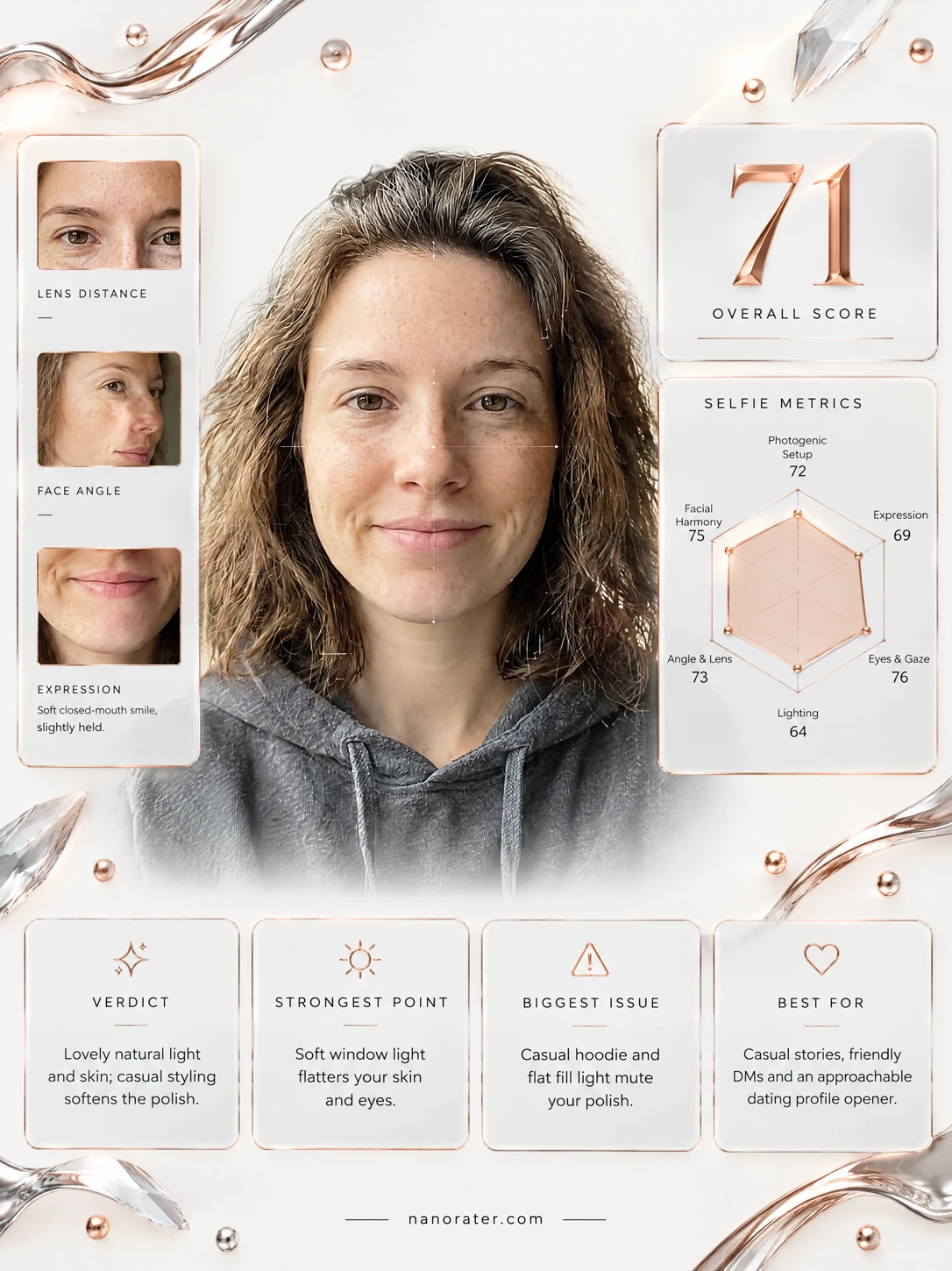
A real report, captured
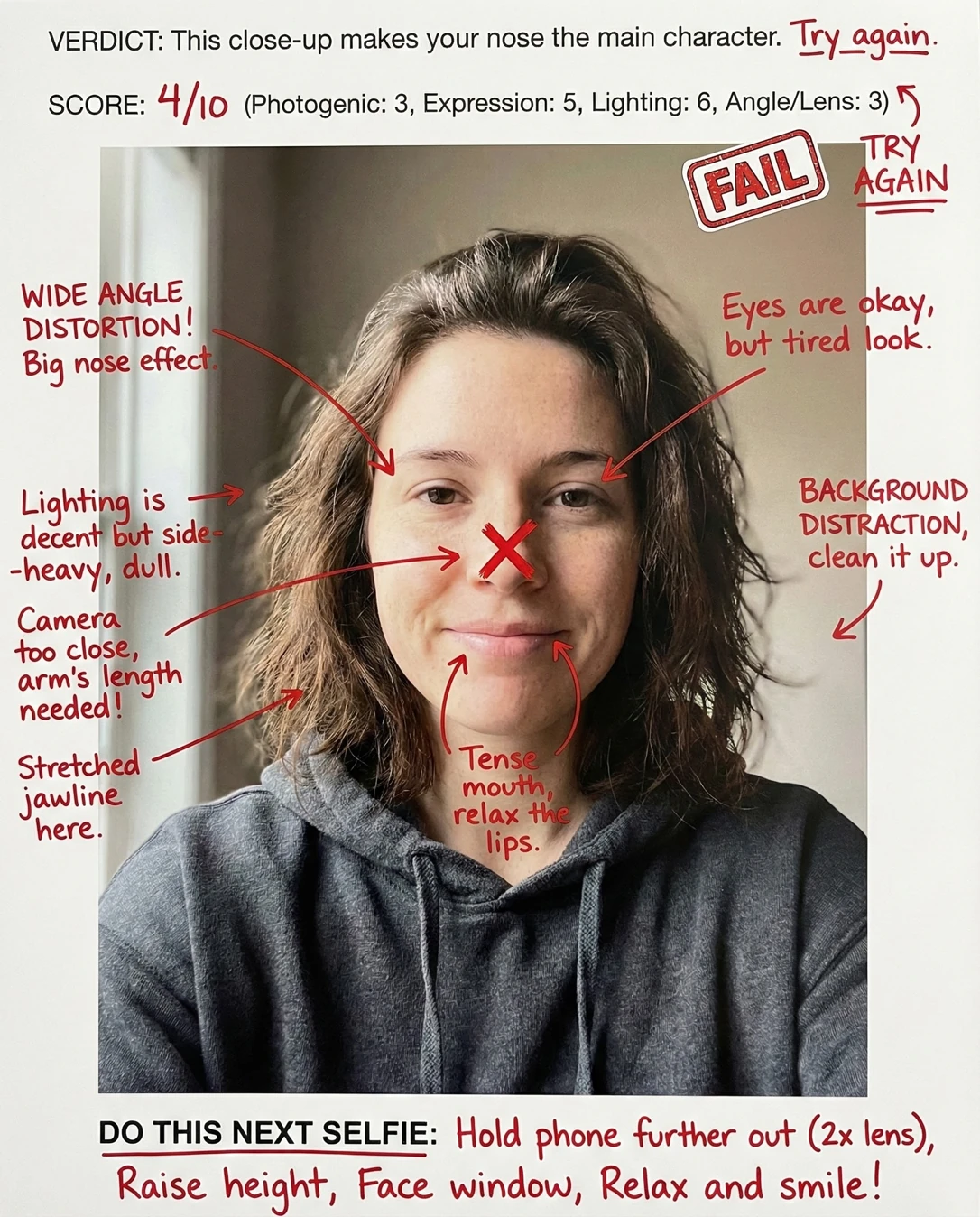
You're already standing in that soft window light most people chase for hours — you've done the hard part, so let's just step you back a pace, turn you into the glow and let that warm face take the whole frame.
Where this photo works
Genuinely works as an everyday selfie: casual social profile shot, a friendly update photo, a secondary dating-app image, a personal blog or Slack avatar where 'real and approachable' beats 'polished'. It does NOT work as a small chat-app thumbnail (the bright window strip and the wall steal half the pixels from your face), as a LinkedIn or professional headshot (casual grey hoodie, flat unmodelled light, no separation), or as an editorial or branded portrait where deliberate styling and controlled lighting are the point.
Quickest fixes
- Turn 20 to 30 degrees toward the window so the light wraps both cheeks rather than one
- Step back about 30 cm and switch to 2x instead of leaning toward the lens
- Raise the phone to brow height with the lens parallel to the floor
Retake plan
- 1.Location: stand 1 to 1.5 metres from a window, angled about 45 degrees to the pane so light sweeps across the face, with a plain wall behind you and no bright window inside the frame.
- 2.Distance: hold the phone at arm's length and then take one step back — roughly 60 to 75 cm from the lens — never closer than 50 cm.
- 3.Lens: shoot at 2x (or at minimum 1.5x). Avoid the ultra-wide front lens entirely; it is what flattens the cheeks and exaggerates the nose.
- 4.Height and tilt: bring the lens to brow or eye level and tilt down no more than two or three degrees, keeping the camera back parallel to your face.
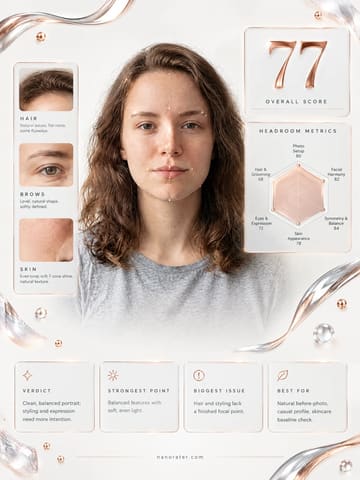
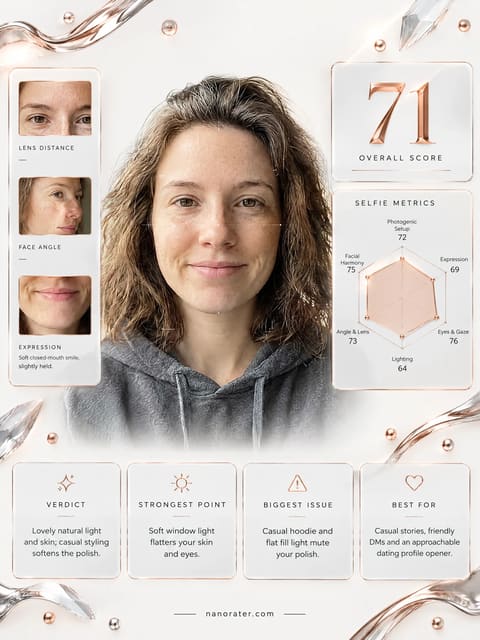
- Lens distance & distortion72
Head-and-shoulders framing captured at conversational distance; nose-to-cheek and nose-to-ear proportions read close to natural with no visible barrel distortion or stretched jaw. Cheek depth is mildly flattened, consistent with a wide-ish front lens rather than a short focal length. Eyes sit above frame centre as measured.
- Camera angle & tilt76
Lens sits near eye level with a slight downward tilt; the eye line lands just above the horizontal midpoint, forehead gains fractionally more space than the chin, and the neck is faintly foreshortened. Shoulders are square and level.
- Lighting quality & direction71
One broad, soft window source from frame-left; shadow falloff across the right cheek is gentle and there is no overhead pooling, flash hotspot or backlight flare. However the background window is significantly brighter than the lit side of the face, so exposure is compromised against the subject.
- Eyes & expression74
Both eyes are open and directly on the lens with no squint and even lid height; catchlights are present but small and low-contrast. The closed-mouth smile is relaxed and symmetric with a mild corner lift — it reads as composed and polite rather than fully engaged.
- Composition & framing73
Subject is centred with a strong head-to-frame ratio and a plain wall behind, giving clean separation. Hair touches the top edge with almost no headroom, and the bright vertical window strip occupies the left margin, splitting attention between face and background.
- Skin quality & texture70
Natural texture is fully preserved: fine pores, freckling across the nose and upper cheeks, a faint flush on the cheeks, no blown highlights and no low-light noise. The tone reads slightly dry and desaturated in the T-zone under the cool light.
- Facial harmony & proportion77
Thirds are balanced, eyes level relative to the frame, brows naturally arched and even in height, nose and mouth centred, jawline defined and visible below the cheek line. Visible asymmetries are minimal and no single feature dominates the composition.
- Symmetry & balance78
Front-on presentation reads highly symmetric; eyes, brows and mouth corners sit level. The only imbalance in the image is light-driven — the lit left cheek against the gently shadowed right — rather than structural.
- Light & colour70
Soft daylight with a faint cool-green cast; the warm, lightly freckled undertone is muted and the grey hoodie dominates the colour story. Overall contrast is low, so the image sits a little flat and the eyes lose their sparkle.
- Styling & grooming66
Grey marl hoodie is casual, with a bulky neckline and drawstrings that crowd the throat and hide the neckline contour. Hair shows natural wave with visible frizz and flyaways breaking the silhouette on both sides; no jewellery or framing accessory.
What works
- The light is already doing the hard work
A single soft window source from frame-left produces a gradual shadow transition across the cheek with no blown highlights, no overhead pooling and no flash reflection on the skin.
- Front-on symmetry that flatters
Eyes, brows and mouth corners sit level in a true front-facing presentation, with a centred face and minimal structural asymmetry.
What holds it back
- Background brightness competes with the face
The window frame along the left edge is the brightest region in the image, brighter than the lit side of the subject, and it occupies a full vertical strip of the frame.
- Cool cast mutes the natural undertone
The overall colour temperature reads faintly cool and greenish; skin that should read warm and lightly freckled appears slightly grey next to the neutral hoodie.