
1. Upload a photo
Choose a recent, unfiltered photo where your face is clearly visible. Front-facing, eye level and soft light give the fairest read.
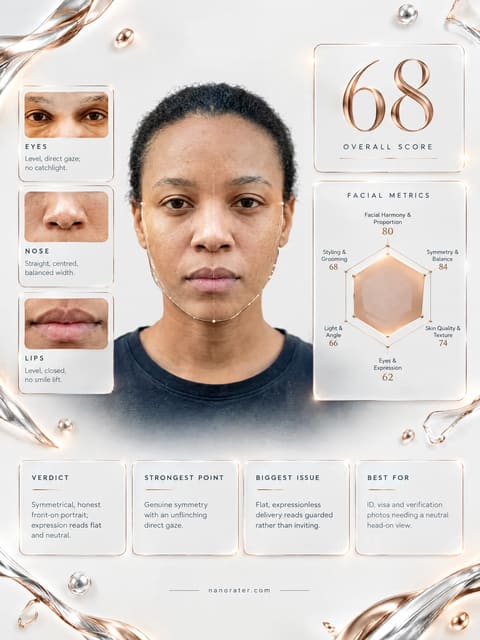 Example output
Free score and summary; free account for the full single-photo report$17.49 once for your Glow-Up Report: AI previews of you with the fixes appliedSee our privacy policy for photo storage and AI processing
Real ratings from Nanorater users, alongside examples of the details and small changes that move a score.
Upload one clear photo of your face — a selfie, a portrait or a profile picture — and this face rater works in two layers. First, an instant face map: measurements of the photo's geometry, made in your browser in about a second, with nothing uploaded, no account and no limit on how many photos you try. Then, if you want it, the AI photo score: a score out of 100, the visible reasons behind it and one change to try on your next shot. Your first AI result needs no sign-up (a guest gets the score and a short summary), and a free account unlocks the full report with the evidence behind every dimension and a retake plan.
Choose a recent, unfiltered photo where your face is clearly visible. Front-facing, eye level and soft light give the fairest read.
Within about a second your browser draws mirror balance, thirds, fifths and length-to-width on your photo and shows where each sits against a reference set.
The AI scores the photo from 0 to 100 against six face-rater criteria and explains what it saw, in plain language.
Turn toward a window, lift the camera to eye level or relax your expression, then rate again to see exactly what moved.
There are two numbers on this page, and they answer different questions. The AI face score answers: how attractive and well balanced does your face read in this photo? It is a 0–100 rating of your face — the percentile beside it shows how it compares with other photos rated here — and it is not a measure of your worth or a prediction of how you look in person. The bands below are the ones the scoring engine itself uses.
The face balance on the instant face map answers a narrower question: how close is the geometry of this photo to the typical value of a small reference set? It is a measurement, not a beauty score, and it changes with every angle, lens and expression.
Face map (instant, in your browser): Google's MediaPipe Face Landmarker finds 478 points on your face. We measure four things from them: how evenly the two sides mirror across the midline (after levelling a tilted head), how the visible face splits into thirds, how its width splits into fifths, and its length-to-width ratio. Each is scored by how close it is to the typical value of a reference set of 1,088 level, frontal photos from a public face dataset, with the formula printed on the result. Typical is not ideal, the reference photos are celebrity-style and mostly lower resolution, and the weights are this tool's own calibration. Your photo is not uploaded for this part.
AI photo score: a vision AI model looks at your photo and scores what is visible against six criteria, and every result explains its evidence. Before it scores, a separate pass reads the photo's conditions — camera angle, eye level, lighting direction, background and crop — so a harsh-shadow selfie is judged as a lighting problem, not as a problem with you. The persona or tone you choose changes how the feedback is worded, never the number.
How balanced the features read — proportions, symmetry, and how the face divides into pleasing thirds.
Left/right balance and feature alignment — how evenly the two sides of the face read in this frame.
Tone, evenness, texture, and how healthy the skin looks under this light.
The gaze, the brow, and the life in the eyes that reads as confidence and approachability.
How the light flatters the face and whether the skin tone reads natural and true.
Hair, grooming, and the finishing details that make the look feel intentional.
Why does the same face score differently from one photo to the next? Lens distance, light direction, expression and crop all change what is visible. The AI can also vary by a few points between runs on the same photo, so read small differences as noise and big ones as signal.
Decades of psychology research on perceived attractiveness point to a few consistent findings — and to a great deal that a single photo cannot show.
Reviews of the literature (Rhodes, 2006) find that more symmetric faces tend to be rated as more attractive, though the effect is modest and varies between studies. In a photo, head tilt and wide-angle distortion can create asymmetry that is not in your face.
Faces close to the average of a population tend to be rated as attractive (Langlois & Roggman, 1990). That is about overall proportions rather than any single feature.
Even tone, clear texture and healthy colour influence ratings (Little, 2014) — and they are exactly what lighting and filters change most.
A genuine, relaxed expression reads as more approachable. A static score under-weights this, and it is the factor you control most easily.
Standards vary across cultures, eras and viewers. No photo test can see who is looking or what they value.
Be honest with yourself about what this tool can and cannot do.
The score rates your face as it reads in this photo. Light, lens, angle and expression still move it, so rate two or three photos and trust the pattern, not a single number.
Vision models learn from data that over-represents some faces and beauty standards. Skin tones, face shapes and features outside that data can be misread. Treat the result as one imperfect opinion.
Nothing here diagnoses a condition or recommends a procedure. It looks at presentation in a photograph and nothing else.
A number from one photo is feedback on that photo. Close the tab, take a new picture in better light another day, or ignore the score entirely.
Soft, even front light is the single biggest upgrade. Avoid overhead light, direct flash and a bright window behind you.
Hold the phone at eye level or slightly above, at arm's length, and use the 2x lens to avoid wide-angle distortion.
Relax your face and think of something pleasant. A real half-smile reads better than a forced one.
Beauty mode and smoothing change what the AI can see, so the score describes the filter instead of you.
Keep the hairline, brows and jaw visible, and keep the background simple so nothing competes with your face.
When you retake, keep the camera, crop and distance the same and change one thing, so any difference in score has a reason.
Questions, answered
Short answers up front. More examples, personas, and photo-improvement guides are on the way.
A face rater is a tool that looks at a photo of your face and gives it a score. This one works in two layers: an instant face map measured in your browser (mirror balance, thirds, fifths and length-to-width), and an AI face rater that scores the photo from 0 to 100 against six criteria (facial harmony, symmetry and balance, skin quality, eyes and expression, light and colour, styling and grooming) and gives you the visible reasons plus a retake plan.
Yes. Upload one clear, front-facing photo and the face rater scores how your face comes across in it. Use a recent, unfiltered image with soft light and the camera at eye level for the fairest result. The score describes that photo, so a different photo of you can score differently.
A face rating here is a 0–100 reading of how well one photo presents your face, with the evidence behind it. 80 and above means the photo works well with only small refinements, the 60s and 70s usually mean one or two fixable factors such as light or angle, and below 60 means a substantial limitation. It is not a ranking against other people.
Upload a photo above. Your first result needs no sign-up: you get the score and a short summary as a guest. A free account unlocks the full single-photo report, within the free rating limit shown in your account.
Yes. A vision AI model looks at your photo and scores what is visible against six criteria. A separate pass first reads the photo's conditions — camera angle, eye level, lighting direction, background and crop — so the analysis is anchored to what is in the frame. Persona and tone change the wording of the feedback, never the score. Separately, the instant face map measures the photo's geometry in your browser.
No. The face map is geometry only: four measurements of the photo, computed in your browser in about a second with nothing uploaded, and unlimited. The AI photo score is a separate judgement of how well the photo works — light, angle, expression and styling — and uses your free ratings. The two can disagree, and that is fine: one measures proportions, the other judges the photo.
No. The face map runs in your browser, and the photo is not uploaded for it. The AI photo score is different: when you ask for it, the photo is uploaded and may be stored so your results and history keep working. See the Privacy Policy for retention and deletion details.
This tool can tell you how attractive this photo of you comes across, and what to change to make it stronger. It cannot tell you how attractive you are as a person: light, lens, angle and expression change a photo a lot, and attractiveness in real life includes voice, movement and warmth that no image shows.
Upload a photo and you will get a direct answer about that photo: a score, what helps it, and what holds it back. Nanorater stays kind but honest, and it focuses on what you can change. It will not hand out a verdict on you as a person, because a single photo cannot support one.
No photo test can decide that, and a low score does not mean it. A low score usually points to something fixable in the photo — harsh shadow, a wide-angle lens, a tilted head. Fix one factor, rate again, and look at the feedback rather than just the number.
It works as a photo-based attractiveness test: it scores the impression one image makes and explains why. It is consistent about the photo, but it is not a scientific measurement of beauty. The same photo can vary by a few points between runs, and it can be biased, so read it as structured feedback rather than a verdict.
Yes. It is an AI attractiveness test in the sense that a vision model reads your photo and scores it, with the evidence shown. The AI score judges how the photo presents you against a face-rater rubric. The instant face map adds measured geometry — mirror balance, thirds, fifths and length-to-width — scored against a small reference set, with the formula shown. Neither is a measurement of beauty.
Yes. Rate your attractiveness here by uploading a photo: you get a 0–100 score for how the photo presents you, the strongest factor, and the largest fixable one. Use it to pick the best photo and improve the next one, not to judge yourself.
It scores out of 100 rather than 10, which lets it show smaller differences between photos. As a rough guide, divide by ten — an 80 is roughly an 8 — but read the band rather than the decimal: 80 and above works well, 60–79 has one or two fixable factors.
Yes. The same six criteria apply to everyone, and they describe the photo — light, angle, expression, skin, grooming — rather than gender. Whether you ask am I handsome, am I hot or am I pretty, you get the same kind of answer: a score for this photo and what to change.
80 and above is a strong result: the photo works well with only small refinements. 70–79 is mostly effective with one meaningful limitation. 60–69 is mixed. Below 60 the photo has substantial limitations, usually light, angle or clarity. A good score is one that fits where you will use the photo.
Often, yes — without changing how you look. Face a window, put the camera at eye level, use the 2x lens, relax your expression and skip filters. Every result includes a retake plan, and most of the movement comes from light and angle. Retakes can help, but a higher score is never guaranteed.
The usual reasons are photo conditions: overhead or harsh light, a wide-angle selfie, a tilted head, heavy filters or low sharpness. Also remember the score is for the photo, not for you. Retake with soft window light at eye level and compare.
A mirror shows a flipped version of you that you are used to. A camera shows you as others see you, and a close wide-angle lens stretches the nose and shrinks the face edges. The face rater flags those effects and suggests how to reduce them.
Not from a front photo. For a profile photograph, use the Side Profile Face Rater, which reads jawline, chin, nose bridge and neck posture from the silhouette.
Rating is free: you get a score and summary without signing up, and the full written report with a free account (2 free ratings). The Glow-Up Report ($17.49 once) adds four AI previews of your own photo with the fixes applied, clean HD downloads and 3 coach questions, with a 7-day money-back guarantee. Pro ($12.99/mo) covers 30 ratings a month for people who keep shooting.
Uploads and outputs are processed by storage and AI providers. Image links can be opened by anyone who has the URL, so avoid sharing links to photos you want to keep personal.
Uploads and outputs are stored to display your results and history. We do not currently promise a fixed automatic deletion period. Contact support for a deletion request.
Contact support to request deletion of your uploads, results, or account data. A self-service deletion workflow is not currently available.
Yes. This product is intended for adults. Do not upload photos of minors. If you are under 18, please do not use Nanorater.
Start with the highest-value tools for face ratings, outfits, profile photos, dating photos, and first impressions.
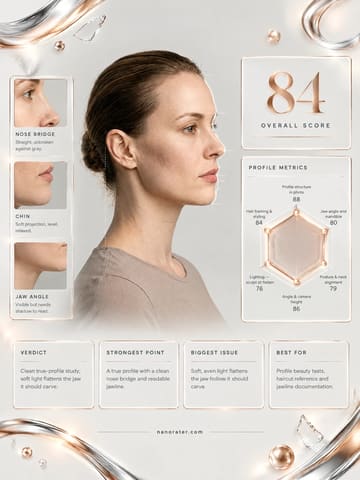
Free AI side profile rater: rate my side profile photo for jawline, nose line and posture, with honest fixes for light and camera height.
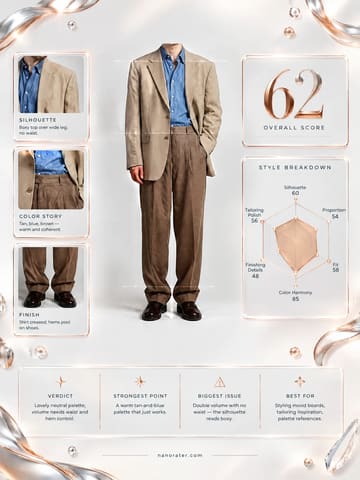
Rate my outfit with AI. This free outfit rater checks fit, proportions and style, then gives 3 quick tweaks and an accessory note for your next photo.
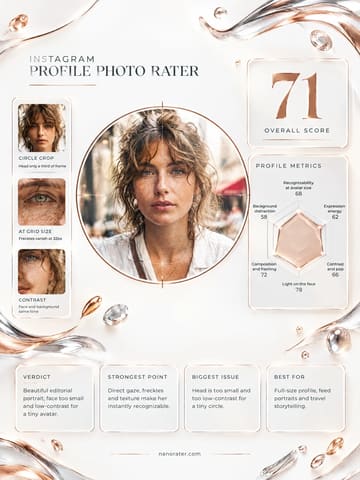
Rate my picture, image, or pic with AI. This Instagram profile photo rater and PFP tester checks crop, contrast, lighting, and background so you stay recognizable in tiny circles and win more profile clicks.
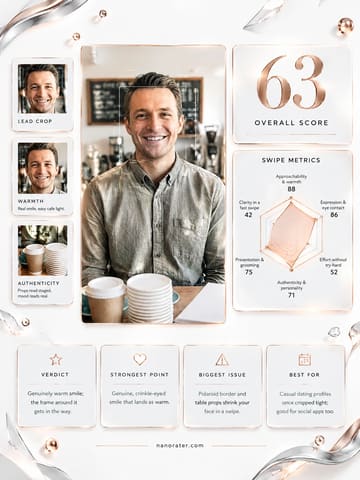
Rate my dating photo with AI. Get feedback on attraction, approachability, and profile-photo effort, plus 1–2 retake ideas that usually improve matches.
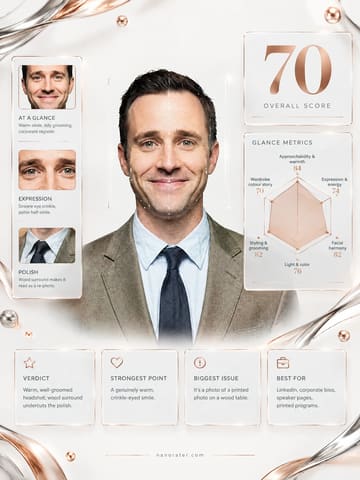
Rate my first impression from a photo. See how your face, expression, and styling read in one second, then fix the #1 issue hurting trust, warmth, or polish.
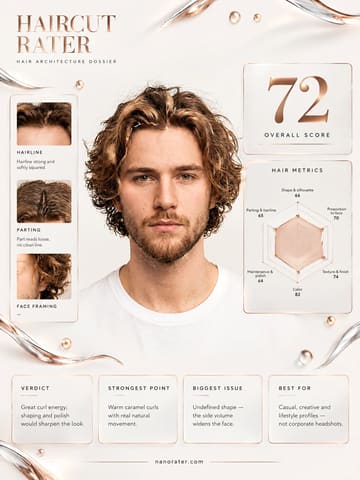
Rate my haircut, hairstyle or hair with AI. This free haircut rater checks face framing, volume, parting and styling, with quick fixes for your next cut.
Two ways to see your photo
Choose annotated Doodle feedback or a deeper Professional report card.
 Your photo
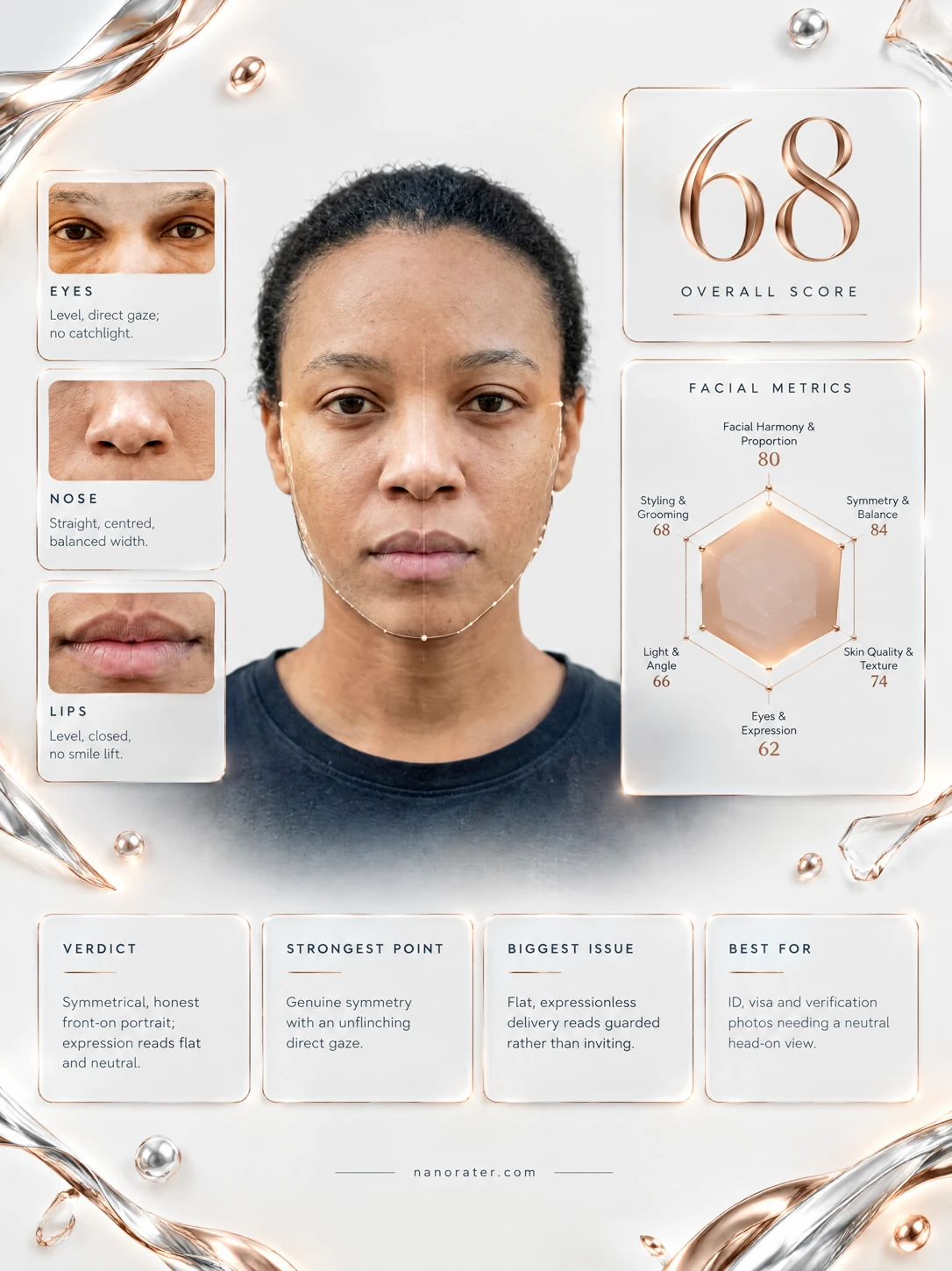 AI result
Get a deeper visual review with neutral feedback and a shareable studio-style report card. The card presents your analysis; it does not retouch your headshot.
The product
Nanorater is a selfie-first face rater: upload a photo, choose a persona, and get a score plus an annotated result with concrete fixes. It is not about perfect. It is about feedback you can use before your next photo.
Choose the point of view you want, from a Chinese auntie who notices everything to a supportive best friend. Different personas focus on different details and use a distinct voice.
Nanorater points to expression, lighting, framing, grooming, and outfit choices, then gives clear fixes you can apply in minutes.
Try a different angle, swap a jacket, step closer to a window, relax your jaw, then rate again and see the feedback change.
Create a free account to see the full report: evidence behind your score and a focused retake plan. A paid clean export includes three coach questions; Pro includes unlimited follow-ups.
Nanorater
Upload one photo and get a practical result with fixes that make the next shot clearly better. Turn uncertainty into a repeatable upgrade loop.