A real report, captured
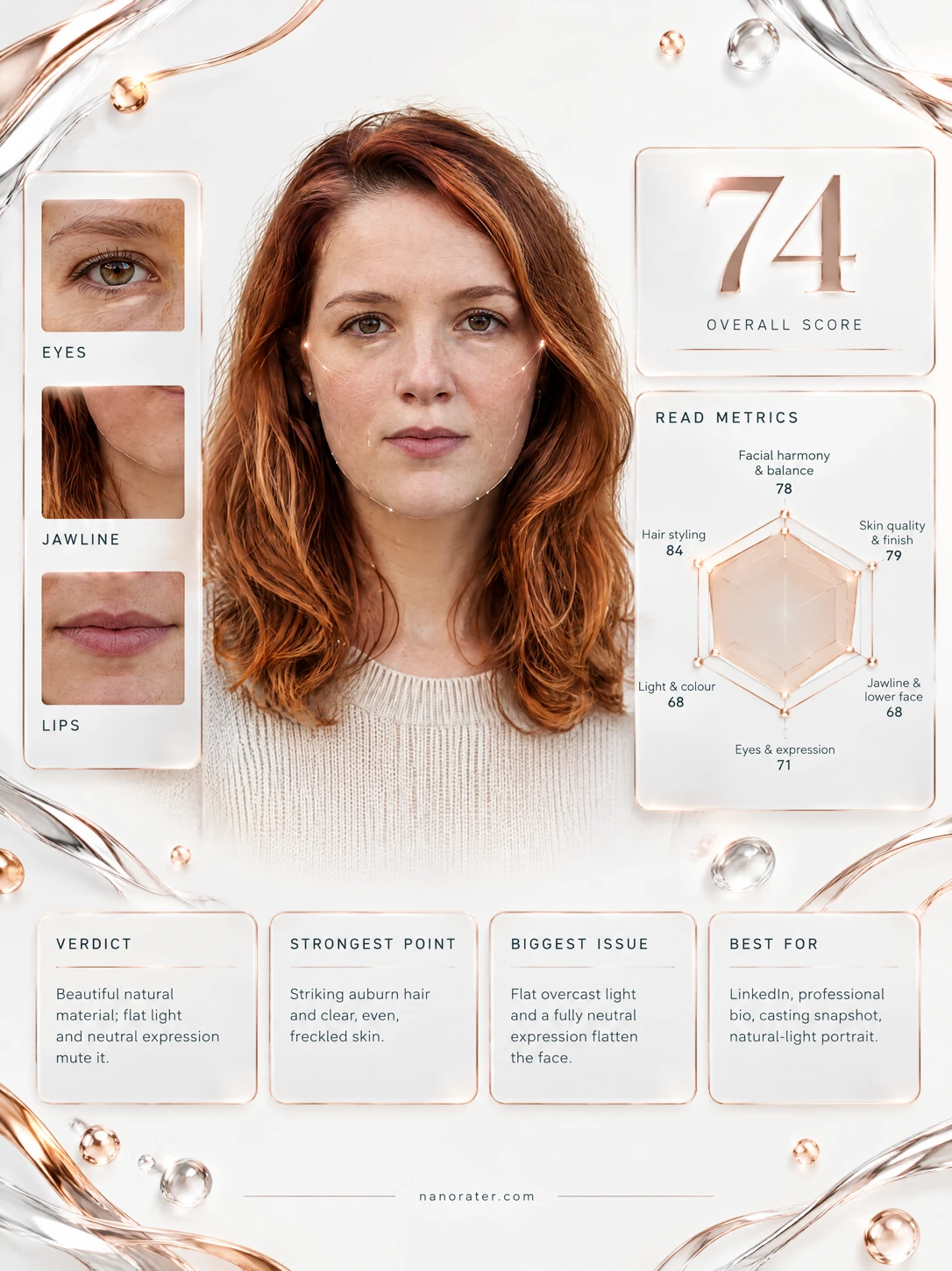
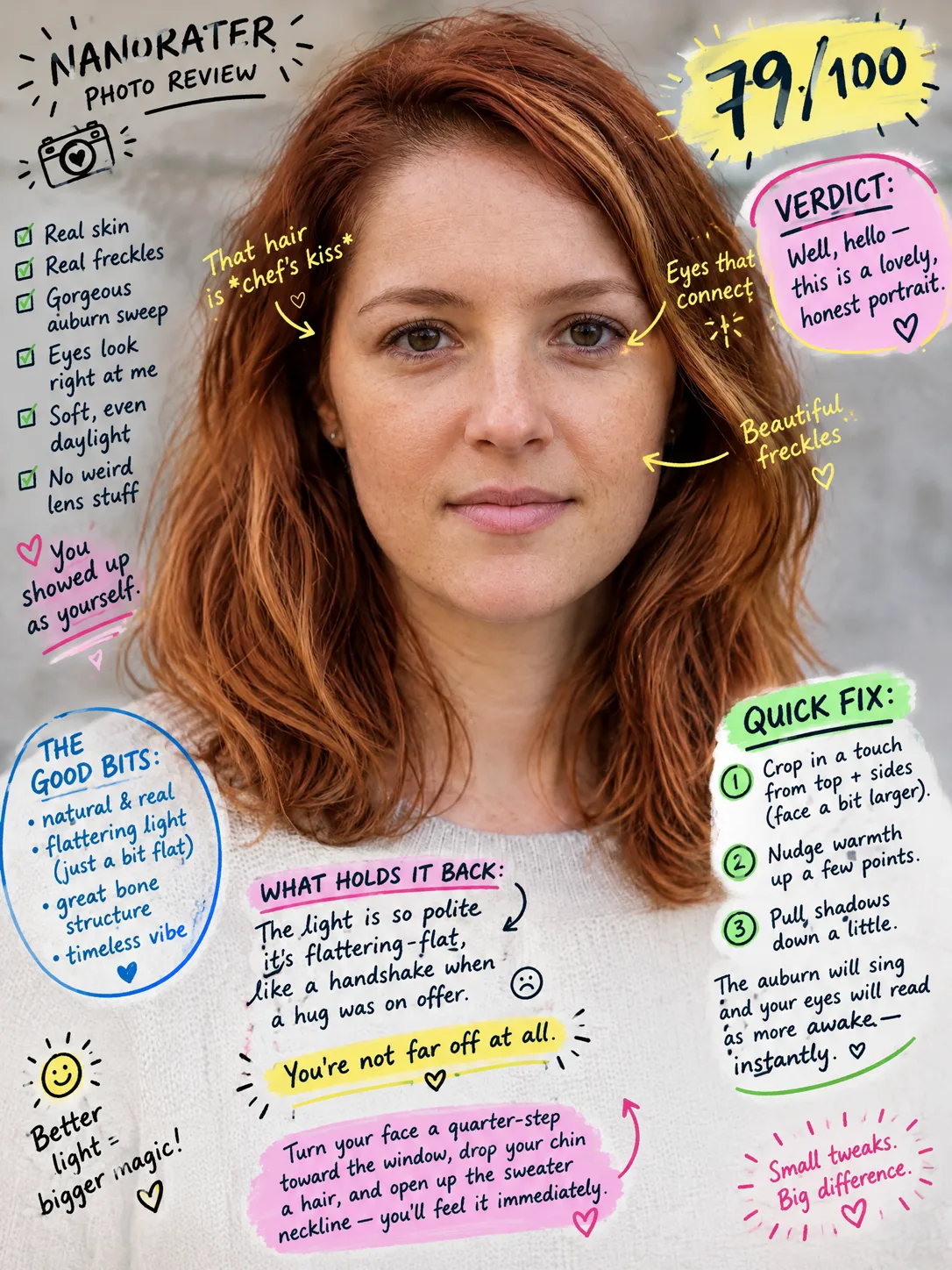
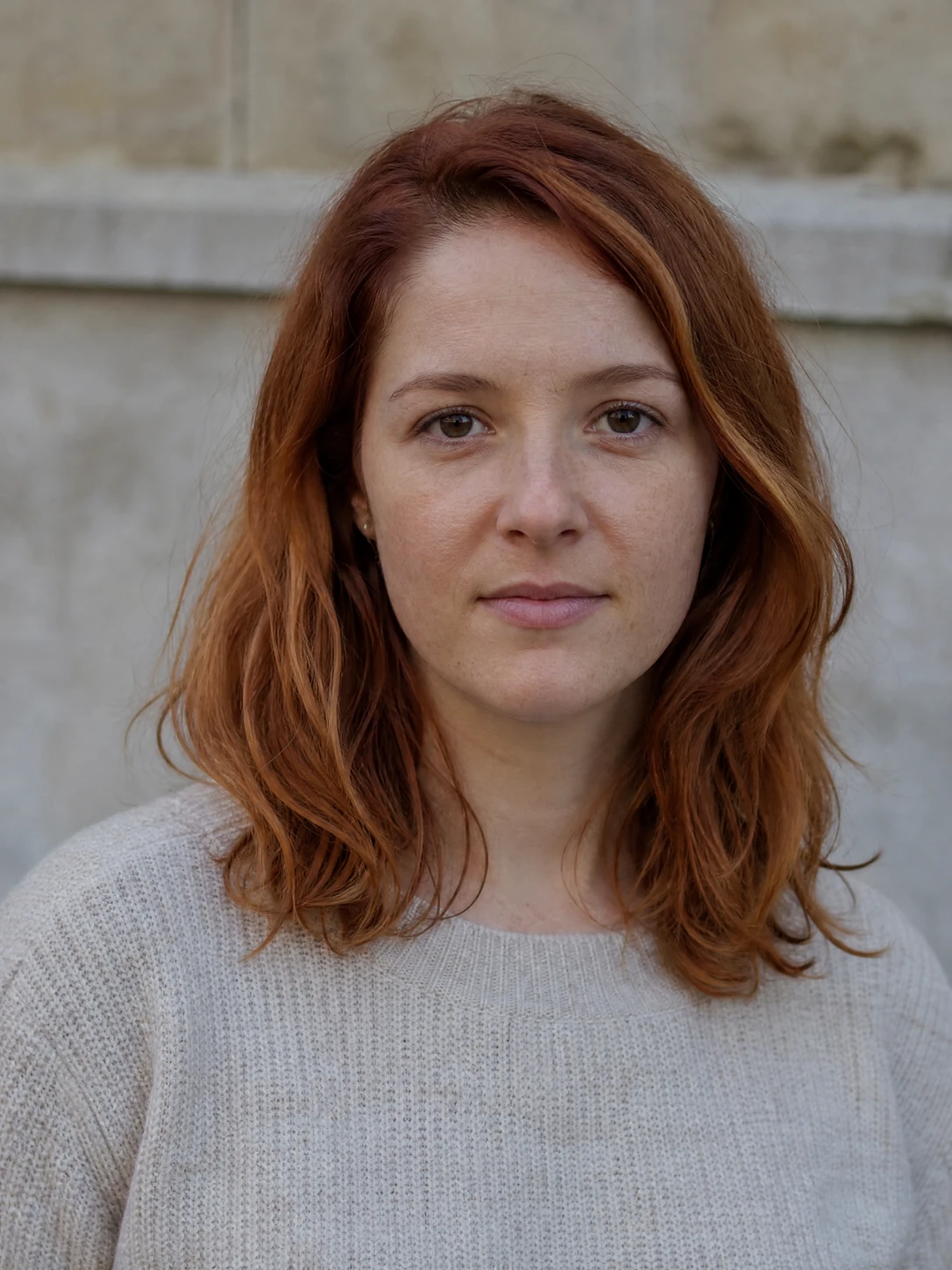
Well, hello — this is a lovely, honest portrait. You showed up as yourself: real skin, real freckles, that gorgeous auburn sweep framing your face, and eyes that look straight at me instead of past me. What I see is a photograph with genuinely good bones — soft, even daylight, no lens weirdness, nothing gimmicky — and one thing holding it back from a knockout: the light is so polite it's not doing any work for you. It's flattering-flat, like a handshake when a hug was on offer. You're not far off at all. Turn your face a quarter-step toward the window, drop your chin a hair, let the sweater neckline open up, and you'd feel the difference immediately.
Where this photo works
As an attractiveness-assessment portrait this holds up well: natural light, no distortion, direct eye contact, and honest presentation — it reads as a sincere, low-gimmick dating-profile or social-bio main photo, and it would also sit comfortably as a soft professional headshot or author/about-page portrait. Where it doesn't win: it's a bit too quiet and unsmiling for a first-swipe dating photo competing in a fast scroll, and it isn't an energy shot — nothing here says 'fun night out' or 'look at my full outfit.' Crop it to a small circular avatar and the fine detail of the hair and freckles disappears, leaving a neutral face against a neutral wall. It also isn't a full-body or event photo, so it can't carry a profile that needs context about your life.
Quickest fixes
- Crop in a little from the top and both sides so the face occupies more of the frame and the faint background ledge stops crowding your crown.
- Warm the temperature slightly and pull shadows down a touch — the auburn and your eyes will both gain presence without going orange.
- Add a small amount of sharpening to the eyes and a whisper of clarity to the hair so the texture leads the viewer's eye.
Retake plan
- 1.Pick the same soft overcast or open-shade light you used here — that part is already right — and shoot roughly an hour after sunrise or an hour before sunset for the gentlest quality.
- 2.Stand about a metre in front of a wall that is clearly darker than your top, or find green foliage behind you, and turn your body about 20° away from the lens while keeping your face toward it.
- 3.Rotate your face 10–15° off-axis to the light so one cheek catches the brightness and the far jaw falls into soft shade; keep the eyes level with the lens, not below it.
- 4.Change into an open-neck top — V, scoop, or a shirt with the top two buttons undone — so the neck and collarbone are visible and the shoulder line has shape.
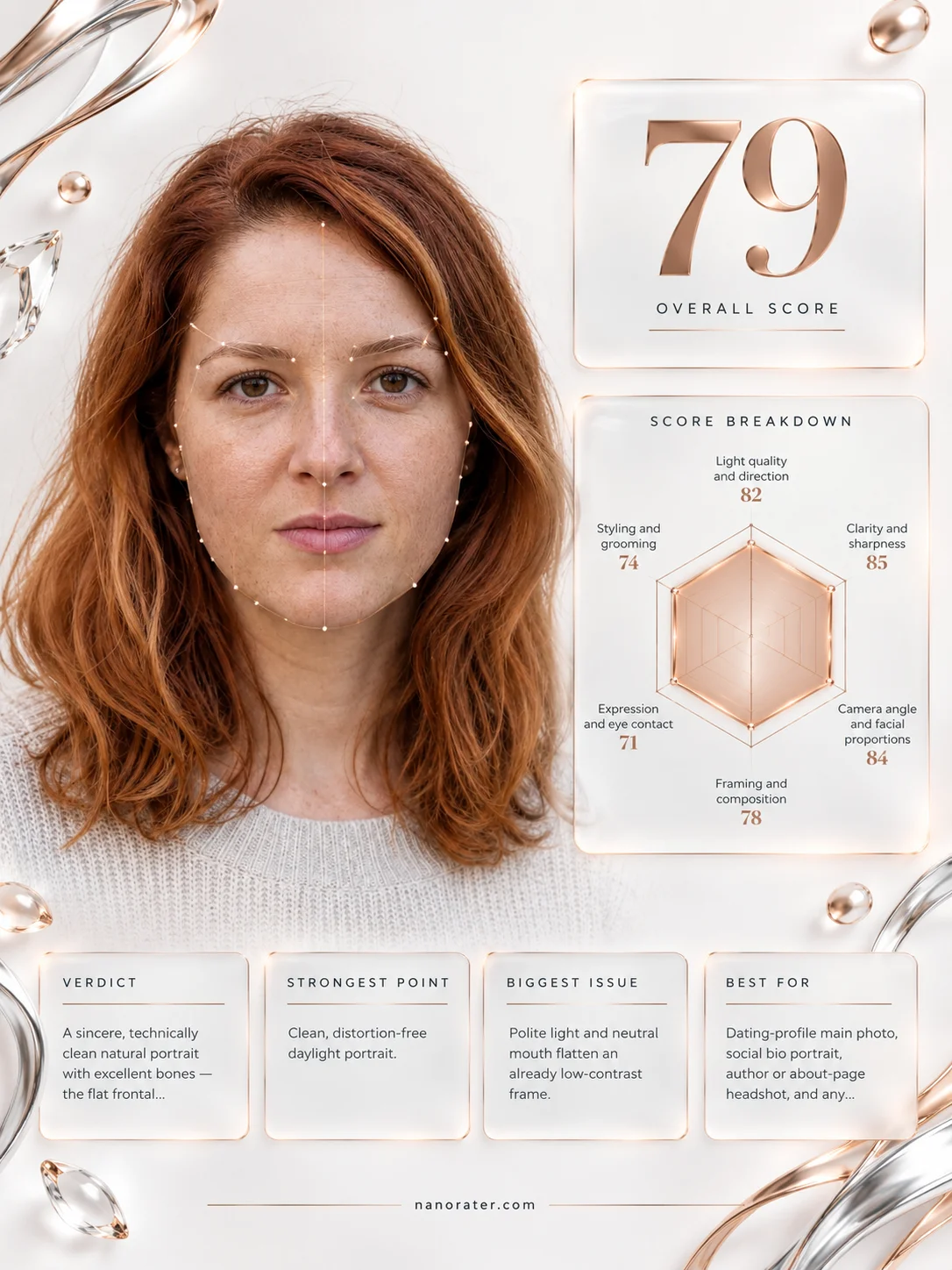
- Light quality and direction82
Diffuse, shadowless daylight with no specular hot spots and no clipped highlights; catchlights sit in both eyes at roughly 10 o'clock, indicating a broad frontal source. The cost is zero modeling on cheekbones and jaw.
- Clarity and sharpness85
Eyes, brow hairs and lip texture resolve cleanly; freckles across the nose and cheeks are preserved rather than smoothed away. Hair detail holds through the mid-lengths with mild softness toward the outer curls, consistent with a wider aperture.
- Camera angle and facial proportions84
Camera sits at or just below eye level and shoots nearly straight on; nose-to-cheek proportions look natural with no wide-angle enlargement, so lens distance is reasonable. The level angle keeps the jawline visually soft.
- Framing and composition78
Head-and-shoulders crop centered in the frame with roughly even margins left and right; the wall behind introduces a faint horizontal ledge line that sits close to the crown, and the crop lands mid-chest without showing the shoulder line.
- Expression and eye contact71
Direct, steady gaze into the lens with relaxed brows and a closed, neutral mouth; no smile tension and no smile warmth either. The eyes engage, the mouth stays guarded, which reads as sincere-but-reserved.
- Styling and grooming74
Hair is worn natural and wavy with a soft off-center part; the mid-lengths are glossy but the outer curls and the crown show light flyaway texture. Skin is presented bare with visible natural freckling and defined brows. The high ribbed crew neckline meets the jaw and hides the neck entirely.
- Colour harmony and subject pop80
The warm auburn hair is the single strongest colour anchor and contrasts well against the cool grey wall; skin undertone reads warm-neutral. The pale oatmeal knit sits very close to the wall's value and hue, so clothing and background merge into one field.
- Background separation69
Background is a flat grey stone surface of similar luminance to the sweater; the lens has softened it slightly but there is no tonal or colour break, so the shoulders and torso read as part of the wall rather than sitting in front of it.
- Posture and body line76
Shoulders are level and squarely facing the camera, which reads as open but static; there's no shoulder-to-head angle or chin extension to create a diagonal, and the torso is cropped before any body line appears.
- Overall presence and naturalness80
Nothing staged or over-produced: no heavy retouching, no forced pose, no prop or filter. The result is trustworthy and easy to look at, with a calm, unarmored quality — but also little momentum or personality spark.
What works
- Even, flattering light with no technical faults
No hot spots, no clipped highlights, no raccoon shadows; exposure holds detail in both the pale sweater and the dark hair, and both eyes carry clean catchlights.
- Natural presentation and honest skin texture
Freckles, brow hair and lip texture are all preserved; there's no over-smoothing or obvious filter, and the gaze is direct and unguarded.
What holds it back
- Flat frontal light gives no facial modelling
The illumination is fully even across both cheeks, leaving cheekbone and jaw contours unlit and making the face read two-dimensional against an equally flat wall.
- Neutral closed mouth reads reserved rather than inviting
Mouth is closed and level, corners unlifted, with no smile tension around the eyes; the expression is sincere but gives the viewer nothing to connect to.