
That Feeling in the Mirror: A Guerilla Guide to Fighting Appearance Anxiety
We’re supposed to care about our minds, our hearts, our accomplishments. But the feeling is real. It’s a heavy, sinking feeling in your gut. It’s a cold knot of dread in your chest.
 Sammy Olsen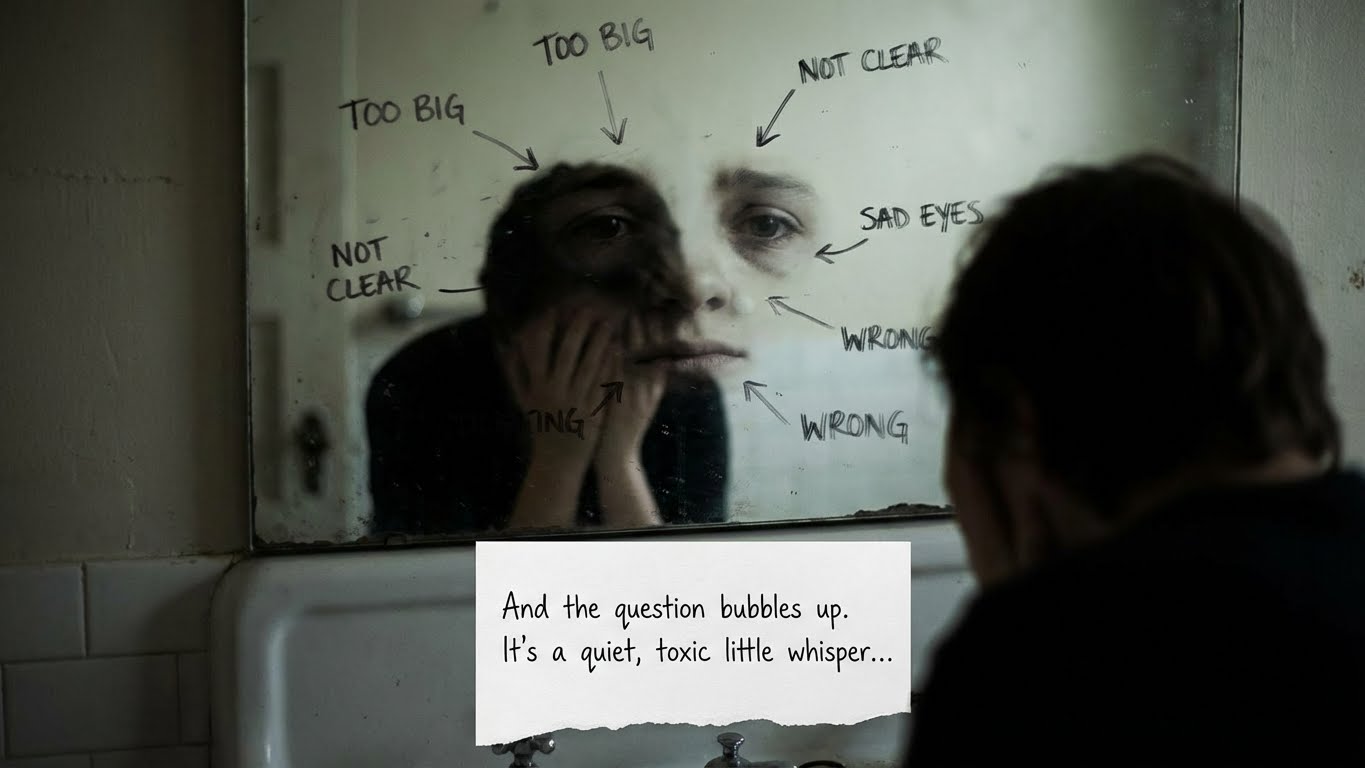
This is a guest post by a friend of the site who has spent way too much time staring at their own reflection.
There’s a specific kind of dread that lives in the mirror. It’s a quiet houseguest, most of the time. It doesn’t demand much.
Some days, you look in the mirror and you see… you. A person. Tired, maybe. Rushed, probably. But a person. You see the face you’ve always had. It’s fine. Whatever. You brush your teeth and move on with your life.
Then there are the other days. The bad mirror days.
On those days, the quiet houseguest starts screaming. You don’t see a person. You see a collection of flaws, a museum of imperfections. You see a nose that’s a little too big, or a little too small, or a little too… something. You see skin that’s not clear enough, not smooth enough, not young enough. You see eyes that are too close together, or too far apart, or just look… sad. You see a face that feels like a stranger’s. A face that feels wrong.
And the question bubbles up. It’s a quiet, toxic little whisper that feels like it’s coming from the deepest, most shameful part of your soul.
“Am I pretty?”
It’s a question that feels childish and vain. We’re supposed to be above it. We’re supposed to care about our minds, our hearts, our accomplishments. But the feeling is real. It’s a heavy, sinking feeling in your gut. It’s a cold knot of dread in your chest. It’s appearance anxiety. And it’s a battle that millions of us are fighting every single day, mostly in silence, inside our own heads.
This isn’t going to be a guide that tells you to just “love yourself” with a picture of a sunset. If it were that easy, you’d have done it already. This is a guide from the trenches. A look at the invisible enemy we’re all up against, and a few weapons—both mental and practical—to start fighting back. This is for the bad mirror days.
The Invisible Prison of “Looking Good”
First, let’s get one thing straight. This isn’t just in your head. You’re not crazy for feeling this way. You’re not broken.
We live inside a giant, invisible pressure cooker. It’s been built around us since the day we were born, and it’s called Western Beauty Standards. It’s a ghost that haunts us. It’s in the movies we watch, where the “normal” girl is a size 2 actress who spent three hours in makeup to achieve that “I woke up like this” look. It’s in the ads on our phones, popping up between videos of cats, selling us creams and potions and lasers to fix flaws we didn’t even know we had five seconds ago. “Do you have strawberry skin? Is your jawline weak? Are your pores visible to the naked eye? Here, buy this expensive goo.”
And most of all, it’s on social media. Social media is the pressure cooker turned up to eleven.
It’s a highlight reel of everyone else’s best moments, best angles, and best filters. We’re scrolling through a curated fantasy world, a digital art gallery where every portrait has been tweaked to perfection. And then we look in the mirror at our own unfiltered, unedited, gloriously normal reality. Of course we feel bad. It’s like trying to compare your daily life to the trailer for a Marvel movie. It’s a rigged game. You are designed to lose.
The pressure is subtle, which is what makes it so dangerous. It’s not a person standing in front of you, telling you that you’re ugly. It’s a thousand tiny images a day, a constant drip-drip-drip of information, telling you what you should look like. A narrower nose. Fuller lips. Smoother skin. A more defined jawline. A thigh gap. No wrinkles. It’s a constantly shifting target of perfection that is, by design, completely unattainable. Because if we could attain it, we’d stop buying things. The whole system is built on making us feel slightly, perpetually inadequate. It’s a business model. And your self-esteem is the price of admission.
So when you have that bad mirror day, know this: you’re not failing. You’re just a normal human reacting to an insane amount of pressure. The first step to breaking out of this prison is realizing that the walls are there. You didn’t build them, but you can start to dismantle them.
Your Brain is a Liar (And a Drama Queen)
So we know the world is a bit nuts. But the biggest, loudest, most vicious battles are usually fought inside our own heads. Your brain can be your worst enemy in this fight. It’s a master storyteller. It can take a small, insignificant detail—a single pimple, a weird shadow—and weave an entire epic tragedy around it. Your brain is a drama queen. And you have to learn how to manage its theatrics.
Mental Trick #1: The Spotlight is Off. The Audience is Texting.
When you’re having a bad face day, you feel like everyone can see it. You feel like you’re walking around with a giant, flashing neon sign above your head that says “MY PIMPLE IS VISIBLE FROM SPACE.” You’re convinced that every person you talk to is just staring at it, mesmerized by its pulsating, volcanic presence.
Here’s the truth, and I say this with all the love in my heart: Nobody cares.
People are so wrapped up in their own lives, their own anxieties, and their own giant, space-visible pimples, that they don’t have the time or energy to scrutinize yours. This is a real, documented psychological phenomenon called the “spotlight effect.” We feel like we’re on a stage, with a single, harsh spotlight following our every move and highlighting our every flaw. In reality, the audience is busy looking at their phones, worrying about what they’re going to have for dinner, and wondering if anyone notices that their own hair is doing a weird thing.
Next time you feel that anxiety creeping in, just repeat this mantra: The spotlight is off. You’re just another person in the crowd. It’s incredibly, profoundly freeing. You have been granted the gift of invisibility. Use it.
Mental Trick #2: Aim for Neutrality, Not Love. It’s Less Work.
The internet is full of people shouting at you to “just love yourself!” It’s a nice sentiment. It’s also completely useless advice when you’re in a spiral of self-hatred. You can’t just flip a switch and go from “I hate my face” to “I am a beautiful, radiant goddess.” It’s too big of a jump. Your brain will call bullshit. It will say, “No, you’re not. Remember that weird shadow from this morning?”
So don’t even try. Aim for neutrality instead. It’s a much smaller, more achievable goal.
Look in the mirror and instead of trying to find things you love, just… describe what you see. In a boring, neutral, scientific way. Like you’re a biologist documenting a new species. “This is a nose. It helps me breathe and smell things.” “These are eyes. They are brown. They allow me to see.” “This is skin. It has some spots on it. It protects my organs.”
Take the emotion out of it. Take the judgment out of it. Just observe. By practicing body neutrality, you’re taking the power away from the anxiety. You’re teaching your brain that your face is just a face. It’s not a measure of your worth. It’s not a report card on your value as a human. It’s just a part of your body. Some days you might like it, some days you might not, but it’s always just… there. And that’s okay. It’s a resting state. From neutral, you can occasionally have a good day. From hate, it’s a long, hard climb.
Mental Trick #3: Curate Your Reality. Be the Bouncer of Your Brain.
You are the bouncer of your own brain. You get to decide who and what gets past the velvet rope. If your social media feed is a VIP section full of people who make you feel bad about yourself, you have the power to change that.
The unfollow button is your best friend. It is a sacred tool. Use it with ruthless efficiency. Unfollow the models with impossible bodies. Unfollow the influencers with perfect, beige lives. Unfollow anyone who makes you feel that familiar, sinking feeling of inadequacy. You don’t owe them your attention. You don’t owe them your mental health.
Then, go on a following spree. Follow people who look like you. Follow people who look nothing like you. Follow artists. Follow writers. Follow scientists. Follow people who are funny, or smart, or interesting for reasons that have nothing to do with their appearance. Follow accounts that post pictures of dogs, or weirdly satisfying factory machines, or beautiful landscapes, or dumb memes.
Fill your digital world with things that make you feel good, or curious, or amused, or at least, not bad. You can’t control the whole world, but you can control your little corner of the internet. Protect it fiercely. It’s your sanctuary.
Practical Tips for When Your Brain is Being a Jerk
Okay, so we’ve done the brain stuff. The psychological warfare. But sometimes you need something concrete. Something you can do right now to feel a little bit better. Here are a few things that actually work.
Practical Tip #1: Master One Tiny, Useless Thing
You don’t need to become a makeup artist. You don’t need a 20-step skincare routine that costs more than your rent. Pick one—just one—small, low-stakes thing about your appearance that you can control and get good at it.
Maybe it’s learning how to do your eyebrows really well. Maybe it’s finding the perfect red lipstick that makes you feel like a 1940s movie star. Maybe it’s mastering a simple, cool hairstyle that takes five minutes. Maybe it’s just finding a great moisturizer that makes your skin feel comfortable and happy.
By focusing on one small, achievable skill, you gain a sense of mastery and control. It’s a little boost of confidence that comes from competence, not from trying to change your fundamental features. It’s not about hiding or fixing. It’s about enhancing and having fun. It’s a form of play. It’s a way of saying, “I can’t change my nose, but I can rock this winged eyeliner.”
Practical Tip #2: The Power of a Good Selfie (Yes, Really)
This might sound counterintuitive. If you’re anxious about your appearance, why on earth would you take more photos of it?
Because the camera on your phone is a liar. It’s a funhouse mirror. The focal length of a front-facing camera can distort your features, making things in the center (like your nose) look bigger and things on the edges look smaller. It’s not an accurate reflection of what you look like to other human beings.
Learning how to take a good selfie is a way of taking back control from the funhouse mirror. It’s about learning the light and the angles that make you feel good. We wrote a whole guide on this, but the short version is: face a window, hold the phone slightly above your head, and take a million photos until you get one you don’t hate.
When you have a photo of yourself that you genuinely like, it’s like a shield. It’s a secret weapon. It’s a reminder on a bad mirror day that you can look good. That the monster you see in the mirror isn’t the real you. It’s just a trick of the light, or a trick of your anxious brain. That photo is proof.
Practical Tip #3: Get Out of Your Head and Into Your Body
Appearance anxiety is a very cerebral, in-your-head experience. You’re trapped in a loop of thoughts and observations. One of the best ways to break that loop is to get out of your head completely and into your body.
Go for a run. Do some yoga. Dance around your room to your favorite song like a complete maniac. Lift something heavy. Do something that makes you feel the power and capability of your body, instead of just seeing it as a decorative object to be looked at.
When you’re focused on what your body can do—run that extra mile, hold that difficult pose, dance with abandon—you have less mental energy to spend on worrying about how it looks. It’s a way of reconnecting with your body as a source of strength and pleasure, not a source of anxiety. It’s hard to worry about the shape of your nose when you’re focused on not falling over in tree pose.
A Tool, Not a Judge: Using Tech for Good
So, where does technology fit into all of this? It can be a source of pressure, for sure. The endless scroll of perfection can be a nightmare. But it can also be a useful tool, if you use it with intention.
Take a site like nanorater.com. It’s a face rater. You upload a photo, and an AI analyzes it based on things like symmetry, skin clarity, and photo quality. Now, you could use this as a weapon against yourself. You could use it to seek validation, to get a score that finally, definitively proves or disproves that nagging question, “Am I pretty?”
Don’t do that. That’s a trap.
Instead, use it as a detached, objective learning tool.
Think of it like this: if you’re learning to play guitar, you might use a digital tuner to see if you’re hitting the right notes. The tuner isn’t judging your musical soul. It’s just giving you data. The nanorater can be the same thing for your selfies.
You can upload a few different photos—one in bad light, one in good light; one from a low angle, one from a high angle—and see what the AI notices. “Oh, the lighting in this one got a higher score.” “This angle seems to be rated as more symmetrical.” It’s a way to demystify the process. It turns the emotional, anxiety-ridden question of “Am I pretty?” into a more logical, technical question of “What makes a good photo?”
By using a tool like this, you can start to see your own face with a bit more objectivity. You can start to separate your self-worth from the technical qualities of a photograph. It’s a way of taking the power back from the mirror and putting it in your own hands. It’s a way of turning a source of anxiety into a source of data. And data is much less scary than feelings.
The War is Long. Be Kind to the Soldier.
Look, getting over appearance anxiety isn’t something you do once. It’s not a final boss you defeat and then the credits roll. It’s a practice. It’s a long, slow, ongoing battle. There will be good days and there will be bad days. There will be days when you feel like a god, and days when you feel like a troll who lives under a bridge.
The goal isn’t to wake up one day and suddenly be free of all insecurity. That’s not realistic. The goal is to have more good days than bad ones. The goal is to have the tools to fight back when the anxiety starts to creep in. The goal is to shorten the bad days. The goal is to remember, in your bones, that you are not your reflection.
You are a whole, complex, messy, interesting person. Your appearance is the least interesting thing about you. It’s just the cover of a very, very long and fascinating book.
So on the bad mirror days, be kind to yourself. Be gentle. You’re a soldier in a war you didn’t ask to fight. Remind yourself that the spotlight is off. Remind yourself that your brain is a drama queen. Go for a walk. Unfollow a supermodel. Put on your favorite song, really loud. And remember that you are so, so much more than a face. You are a force. Now go act like it.